Abstract
The local printing industry is integral to the global economy, particularly in sectors like education and media. Despite its potential, the industry faces significant challenges that hinder growth and efficiency. With a local production capacity of approximately 158 million textbooks, there is a compelling opportunity to reduce dependency on imported materials, which currently costs around $35.78 million annually. This financial drain not only affects foreign currency reserves but also limits local job creation and stifles technological innovation. The local printing sector could increase employments from 5,000, to 7,506, if the text books printing allowed locally. This growth would not only empower communities economically but also foster technology transfer, helping local firms remain competitive in the global market. However, many businesses struggle due to outdated technology and infrastructure, which restricts production capacity and product quality. Additionally, attracting skilled labor is a notable challenge, exacerbated by a lack of vocational training and awareness of career opportunities in printing Industries. Market uncertainties, compounded by fluctuating raw material prices and insufficient financial resources, further inhibit competitiveness. The absence of comprehensive government policies to support the local printing Industry sector significantly limits growth potential. A thorough assessment of the industry's capability to meet educational demands is crucial for identifying operational strengths and critical issues. Addressing these challenges can lead to a more resilient local printing industry that contributes to educational sustainability and broader economic development.
Keywords
Challenges, Economic Role, Job Creation, Market Competition, Policy Framework, Printing Industry, Technology
1. Introduction
The printing industry plays a crucial role in global economy and significantly impacting various sectors like education, media, and marketing
| [1] | Almakaty, S. S. “History and Development of Printing Industry in Saudi Arabia: Review and Discussion.” International Journal of Media, Journalism and Mass Communications. 2024, 10(1), 65-72.
https://doi.org/10.20431/2454-9479.1001006 |
[1]
. Job creation, saving of foreign currency and the exchange of technological knowledge are contributions of printing industries. The dependency on imported textbooks presents a major challenge, draining precious foreign exchange and limiting local job opportunities while hindering technological innovation and adaptation
.
With an estimated local production capacity of approximately 158 million textbooks across three shifts, the potential for the local printing industry to meet educational material demands is significant. However, the current annual expenditure of around $35.78 million on imported textbooks underscores the need for greater self-sufficiency. This substantial financial out flows not only impacts on foreign currency reserves but also illustrates the missed opportunities for local job creation and economic development
| [3] | Mtshali, E. P., Nyakala, K. S., Munyai, T. T. “Identifying Causes of Low Productivity in the Printing Industry.” 2018, pp. 933-944. |
[3]
. Each locally produced textbook represents potential savings through reduced import costs and provides an opportunity to develop local talent, further enhancing economic resilience and sustainability.
The local printing industry, currently employing over 5,000 individuals, plays a critical role in job creation in one shift and job will increase to more 7,506 employees if the opportunity to print textbook in local is allowed. Printing facilities create employment opportunities that empower individuals to invest in their communities and futures. Additionally, local printing firms can facilitate technology transfer by integrating advanced printing methods and allowing them to remain competitive in the global market while improving the quality of their outputs
| [4] | Liu, Y., Li, F., Zhao, D., Tao, J. “Digital Printing Helps Printers to Transform and Develop: A Study of 8 Printers Around Beijing, Tianjin, and Hebei.” Proceedings of the 2023 3rd International Conference on Financial Management and Economic Transition (FMET 2023). Atlantis Press, 2023.
https://doi.org/10.2991/978-94-6463-272-9_16 |
[4]
.
Despite these advantages, the local printing sector, particularly in textbooks, faces several obstacles that limit its growth and efficiency
. A major challenge is the lack of modern technology and infrastructure. Many local printing businesses still operate with outdated machinery and practices, restricting their production capacity and the quality of their products. Without access to contemporary technology, these companies struggle to compete with international suppliers who can provide better products at lower prices. The absence of technological advancement hampers innovation and responsiveness to the evolving demands of the educational market.
Furthermore, the challenge of attracting and retaining skilled labor represents another significant barrier. The printing industry requires a workforce with specialized technical expertise, creativity, and a grasp of current marketing trends. However, a gap in vocational training and insufficient awareness of career opportunities in printing has resulted in a shortage of qualified professionals. This skills deficit not only limits the industry's ability to enhance its services but also raises concerns about its long-term viability.
Market challenges compound the difficulties faced by local printing firms. The Sourcing of raw materials can be problematic, as many businesses rely on imports. Price volatility of these materials can cause production delays and increased costs, ultimately diminishing competitiveness and profitability. Additionally, acquiring sufficient financial resources remains a challenge, as local printing companies often lack the collateral or credit history needed to secure funding. Without appropriate financing, these businesses struggle to invest in modern technologies or expand to meet market demand.
Broader national and international economic conditions significantly influence the fortunes of local printing industries. The Shifting in global market dynamics can change demand patterns, while regional economic instability complicates planning and forecasting for local printers
| [5] | Mathews, B. “Dynamics of Networking: A Case Study of Printing Industry in Kerala.” Business Economics. 2019, 6(6), 673-675. |
[5]
. This uncertainty, further aggravated by fluctuating exchange rates and evolving trade environments, can dissuade investment and stifle innovation.
One area where these challenges become particularly evident is the lack of comprehensive policies designed to support the local printing sector
| [6] | Gebrewolde, T. M., Rockey, J. “The Effectiveness of Industrial Policy in Developing Countries: Causal Evidence from Ethiopian Manufacturing Firms.” Journal of Development Effectiveness. 2022, 00(00), 1-27.
https://doi.org/10.1080/19439342.2022.2090997 |
[6]
. Effective government initiatives and regulatory frameworks are essential for creating a favorable environment for local businesses. Unfortunately, insufficient attention to the development of specific policies leads to missed growth opportunities and negatively impacts the industry's potential for sustainability
| [7] | Gebrehiwot, B. A. “Industrial Policy and Structural Transformation in Ethiopia.” 2022. |
[7]
.
Given these compounded challenges, a comprehensive assessment of the local printing industry's capability to produce textbooks is essential. Understanding how well the sector meets local educational material demands not only reveals its current operational capacity but also outlines the critical issues that must be addressed for future growth. This assessment will focus the economic importance of the local printing industry and demonstrate how overcoming existing obstacles can create a vibrant sector that supports educational sustainability and contributes significantly to broader economic development.
1.1. Statement of the Problem
Ethiopian education system is confronted with significant challenges due to its heavy dependence on imported student textbooks. Despite the capability of local printing industries to produce approximately 158 million student textbooks annually, the country continues to spend considerable foreign currency on importing these educational materials from abroad
| [8] | Krishnaswamy, N. “A Study on the Effect of Population Growth on Printing Industry in India.” International Journal of Advanced Multidisciplinary Research and Studies. 2025, 5(5), 1210-1214. https://doi.org/10.62225/2583049X.2025.5.5.5097 |
[8]
. This reliance not only strains foreign currency reserves but also obstructs the growth and development of the local publishing sector.
Adding to this dilemma is the trend of local printing companies winning bids to print student textbooks for foreign markets. While this presents an opportunity for revenue generation, it detracts from the domestic capacity to meet the educational needs of local students, adversely impacting job creation and curtailing the potential for technology transfer within the country
| [9] | Gyamfi, F. D. “The Triple Bottom Line of Printing Enterprises in Accra: Evaluating Economic Performance, Environmental Sustainability and Social Responsibility.” Journal of African Arts & Culture. 2025, 8(1), 77-109.
https://doi.org/10.63102/jaac.v8i1.20254 |
[9]
. Consequently, local printers are not fully engaged in supporting their communities or enhancing the capabilities of their workforce.
Moreover, the capacities of local printing industries to produce student textbooks and the specific challenges they encounter have yet to be comprehensively assessed
| [10] | Latif, N. A., Azly, N., Ali, M. “Skilled Workers Shortages in the Printing Industry: Perspectives from Industry Experts.” International Journal of Entrepreneurship and Management Practices. 2025. https://doi.org/10.35631/IJEMP.728029 |
[10]
. Without thorough evaluation of the existing infrastructure, technological capabilities, and workforce skills, it remains uncertain how the local publishing sector can effectively transition from a reliance on imported textbooks to a self-sufficient production model
| [11] | Kulkarni, V. D. “Role of Technology in Developing Indian Print Industry.” International Journal of Information Technology and Management. 2021, 16(1), 1-7. |
[11]
. This lack of assessment inhibits the identification of critical areas for improvement, innovation, and investment, ultimately limiting the local printing sector's potential to contribute to educational sustainability and economic development in Ethiopia.
Therefore, addressing these interconnected problems through a comprehensive evaluation of the local printing industry's capabilities and challenges in producing student textbooks is essential. Only by understanding the true potential of domestic production, Ethiopia can move toward a more self-reliant and economically viable education system that reduces foreign currency loss while fostering job creation and technological advancement within its borders.
1.2. Scope of the Study
The scope of this study focuses on its current status, printing capabilities, job creation, technological utilization, and the challenges it faces in producing student textbooks locally.
1.3. Objectives of the Study
1) To provide a detailed overview of the Ethiopian printing industry, including the number of active publishers, job opportunities, market condition, and the variety of services offered.
2) To analyze the production capacity of local printing firms for student textbooks, and ability to meet current book demands.
3) To evaluate the extent to which local publishers in Ethiopia have adopted modern printing technologies and analyze their implications for productivity and quality.
4) To identify key challenges in the Ethiopian printing industry, recommend strategies to enhance capacity and sustainability for high-quality textbook printing.
1.4. Activities of the Study
1) Conduct a literature review and analysis of existing reports on the Ethiopian printing sector.
2) Design and distribute a survey targeting active printing publishers to gather data on the number, types, and services offered by these firms.
3) Collect and analyze quantitative data on student textbook printing capabilities from local firms through surveys, interviews, and field visits to evaluate the industry's ability to meet current demand.
4) Develop a survey to collect data on employment levels, job types, and demographics in local printing firms, and conduct interviews with employers to evaluate economic impact and job growth potential.
5) Survey printing firms regarding their equipment, software, and printing techniques.
6) Organize workshops or interviews with industry experts and managers to identify and discuss challenges of the sector.
7) Carry out a SWOT analysis (Strengths, Weaknesses, Opportunities, and Threats) of the printing industry based on collected qualitative and quantitative data.
8) Collaborate with industry experts to create a strategic plan that includes recommendations for improving capacity and sustainability in the local printing industry.
9) Prepare a comprehensive report that outlines the strategies, including a roadmap for implementation and potential partnership opportunities for enhancing local production of high-quality student textbooks.
1.5. Significance of the Study
1) The study was provided essential insights into the Ethiopian printing industry by identifying the number of active publishers, market conditions, and service offerings.
2) Serves as a critical resource for policymakers and educational stakeholders.
3) By analyzing local printing firms’ ability to meet student textbook demands, the project will highlight production capabilities and limitations.
4) The study was guided targeted interventions to enhance local production and reduce reliance on costly imports, reinforcing educational self-sufficiency in Ethiopia.
5) Investigating employment generated by the printing industry underscores its role in job creation and economic development.
6) Assessing the adoption of modern printing technologies was identified gaps and areas for improvement.
7) Recommendations stemming from this analysis can enhance productivity and quality, enabling local firms to compete effectively in both domestic and international markets.
1.6. Limitations of the Study
Gathering comprehensive data from the printing industry can be challenging due to several factors. One major issue is that some printing businesses may be unwilling to voluntarily share the necessary information, leading to significant gaps in the data collected. Additionally, there may be a lack of understanding or technical expertise among industry participants regarding how to accurately complete data collection forms, which can undermine the reliability and accuracy of the information provided. The situation is further complicated by the fact that existing industry associations may not be robust or well-organized enough to effectively promote data sharing and collaboration across the sector. Moreover, some businesses might participate in the study primarily to gain access to potential government support, rather than to contribute meaningfully, which can skew both participation levels and the quality of data collected. Lastly, limited funding for such assessments can restrict the ability to cover all regions and players within the printing industry, potentially resulting in an incomplete or biased representation of the market landscape.
2. Methodology of the Study
This study employed both qualitative and quantitative research designs to gather comprehensive insights into the Ethiopian printing industry. It focused up on in-depth interactions with industry stakeholders to ensure a thorough understanding of the market. Researchers conducted in-person visits to various printing companies across different regions, allowing for direct observation of operations and the collection of firsthand information. Structured interviews were held with industry managers and key personnel to discuss their experiences, challenges, and perceptions regarding market conditions and service offerings. A purposive sampling method was employed to select a diverse range of printing companies, encompassing both large and small enterprises, ensuring a comprehensive representation of the industry landscape. The data collected from interviews and discussions were transcribed and analyzed thematically, identifying key patterns and insights relevant to the current state of the printing industry in Ethiopia. To enhance the reliability of the findings, follow-up discussions were conducted with some participants to validate the insights gathered and ensure their accuracy.
2.1. Data Analysis
The table presents an overview of the printing capacities of various publishing industries in Ethiopia, detailing their monthly and annual production capabilities across different operational shifts. The total annual printing capacity is approximately 397 million units, with monthly outputs of about 3.8 million units in one shift, 7.6 million units in two shifts, and 11.4 million units in three shifts. This demonstrates a significant potential to meet the country's demand for printed materials, especially student textbooks. The technologies employed primarily include web and offset printing, reflecting a reliance on modern methods to enhance production efficiency. Additionally, the working capital varies widely among firms, which influences their capacity to invest in resources and technologies crucial for growth.
Table 1. Local Printing Industries Capacity.
S. N | Name of printing industry | Printing capacity per year | Actual Monthly book printing capacity in one shift | Monthly book printing capacity in three shifts |
1. | Abay printing and paper packaging factory | 47,160,000 | 972,222 | 2,916,666 |
2. | EMPDE | 19,500,000 | 375,000 | 1,125,000 |
3. | Berhan selam printing enterprise | 16,410,000 | 364,666 | 1,094,000 |
4. | Mega printing plc | 19,968,000 | 400,000 | 1,200,000 |
5. | Melba printing, packaging and publishing | 155,750,400 | 338,000 | 1,014,000 |
6. | Birana Printing enterprise | 8,312,484 | 35,057 | 105,173 |
7. | Bole printing press | 4,611,650.4 | 106,751 | 320,253.5 |
8. | Dehir paper converting and packaging manufacturing plc | 47,923,200 | 416,666 | 1,250,000 |
9. | Chamber printing house | 24,000,000 | 250,000 | 750,000 |
10. | Master printing | 1,728,000 | 40,000 | 120,000 |
11. | Universal printing press | 1,248,000 | 20,800 | 62,400 |
12. | Jajaw printers and developers plc | 1,444,265 | 7,782.13 | 23,346.41 |
13. | Fullas printing press | 2,190,000 | 30,416 | 91,250 |
14. | Central printing press | 32,256,000 | 173,333 | 520,000 |
15. | Tikur Abay Printing Press | 1,500,000 | 33,000 | 100,000 |
16. | KALU Printing PLC | 6,000,000 | 66,600 | 200,000 |
17. | Rehobot PRINTERS PLC | 700,000 | 16,000 | 50,000 |
18. | CONTINENTAL PRINTERS PLC | 700,000 | 16,000 | 50,000 |
19. | Nejashi Printing and Packaging | 500,000 | 10,000 | 30,000 |
20. | Africa Printing P L C | 700,000 | 16,000 | 50,000 |
21. | Meron Printing Trade | 500,000 | 10,000 | 30,000 |
22. | Salem printing press | 400,000 | 8000 | 25,000 |
23. | CTM printing PLC | 350,000 | 10,000 | 30,000 |
24. | Benecia printing press | 500,000 | 10,000 | 30,000 |
25. | Falcon Printing Enterprise PLC | 500,000 | 10,000 | 30,000 |
26. | Artistic printing press | 1,500,000 | 33,000 | 100,000 |
27. | Post printing press | 350,000 | 8,300 | 25,000 |
28. | MYBT PRINTING PRESS | 400,000 | 8,300 | 25,000 |
| Total | 397,101,999 | 3,785,895 | 11,367,089 |
S. N | Name of printing industry | annual textbook printing capacity per one shift | annual textbook printing capacity per three shift | Technology type | Working capital |
1. | Abay printing and paper packaging factory | 11,666,666 | 35,000,000 | Web and offset | 350,000,000 |
2. | EMPDE | 4,500,000 | 13,500,000 | Web and offset | 241,491,801 |
3. | Berhan selam printing enterprise | 4,376,000 | 13,128,000 | Web and offset | |
4. | Mega printing plc | 4,800,000 | 14,400,000 | Web and offset | 112,159,229.26 |
5. | Melba printing, packaging and publishing | 4,056,000 | 12,168,000 | Web and offset | |
6. | Birana Printing enterprise | 420,692 | 1,262,076 | Web and offset | 230,003,270.33 |
7. | Bole printing press | 1,281,014 | 3,843,042 | Web and offset | 490,154,093 |
8. | Dehir paper converting and packaging manufacturing plc | 5,000,000 | 15,000,000 | Web and offset | 202,710,000.00 |
9. | Chamber printing house | 3,000,000 | 9,000,000 | Web and offset | 67,808,325.58 |
10. | Master printing | 480,000 | 1,440,000 | Offset | |
11. | Universal printing press | 249,600 | 748,800 | Offset | |
12. | Jajaw printers and developers plc | 93,385.66 | 280,157 | Offset | 23,128,872.49 |
13. | Fullas printing press | 365,000 | 1,095,000 | Offset | 10,000,000 |
14. | Central printing press | 2,080,000 | 6,240,000 | Offset | 38,854,562 |
15. | Tikur Abay Printing Press | 400,000 | 1,2000,000 | Web and offset | |
16. | KALU Printing PLC | 800,000 | 2,400,000 | Web and offset | |
17. | Rehobot PRINTERS PLC | 200,000 | 600,000 | Offset | |
18. | CONTINENTAL PRINTERS PLC | 200,000 | 600,000 | Offset | |
19. | Nejashi Printing and Packaging | 120,000 | 360,000 | | |
20. | Africa Printing P L C | 200,000 | 600,000 | Offset | 16,000,000 |
21. | Meron Printing Trade | 120,000 | 360,000 | offset | |
22. | Salem printing press | 100,000 | 300,000 | offset | |
23. | CTM printing PLC | 120,000 | 360,000 | offset | |
24. | Benecia printing press | 120,000 | 360,000 | offset | |
25. | Falcon Printing Enterprise PLC | 120,000 | 360,000 | offset | |
26. | Artistic printing press | 400,000 | 1,2000,000 | Web and offset | |
27. | Post printing press | 100,000 | 300,000 | offset | |
28. | MYBT PRINTING PRESS | 100,000 | 300,000 | offset | |
| Total | 45,468,358 | 158,005,075 | | |
Last five years import of printed items
The below
Table 2 indicates the import of printed items during five years. Accordingly the import values of Printed books, brochures and similar printed matter have decreased during 2019-2022 and increased during 2023 due to curriculum change in Ethiopia.
Table 2. Import if Printed Items.
Product label | Imported value in 1000 USD |
2019 | 2020 | 2021 | 2022 | 2023 | 2024 |
Printed books, brochures and similar printed matter, whether or not in single sheets | 54,822 | 14,026 | 9,524 | 16,049 | 84,497 | 35,783 |
Source: Ethiopian custom commission.
2.2. Student Text Books Demand Analysis
The demand analysis for student textbooks in Ethiopia reveals a substantial need for educational materials, with a total estimated requirement of approximately 231.3 million textbooks. This figure is derived from the number of students across primary and high schools and the average number of textbooks each student requires. This indicates that if peace and security be maintained across all regions, and with accurate data collection from various cities and regional educational bureaus, it is anticipated that the demand for textbooks will further increase to above 300,000,000. This high printed textbook need indicates there is an opportunity for local printing industries to upgrade and produce quality textbook for the need of the countries.
Table 3. Need analysis of student text book.
| Kg | Primary School | High School |
Number of students | 3,750,413 | 17,611,631 | 2,634,181 |
Average text book per students | 3 | 11 | 10 |
Total text books demand annually | 11,251,239 | 193,727,941 | 26,341,810 |
Total | 231,320,990 |
Source: National plan commission report.
2.3. Basic Raw Materials for Student Textbook
There are many primary raw materials used in textbook printing
| [12] | Masod, M. Y., Zakaria, S. F., Author, C. “Redefining Malaysia’s Printing Landscape: Insights from Porter’s.” 2024, 19(1). |
[12]
. For the paper, sheet-fed printing typically utilizes 80 grams per sheet, while web printing requires roll paper. The cover pages are printed on 250 grams art paper, providing durability and quality. Ink is another essential input for achieving vibrant and accurate colors during the printing process. Glue and wires are utilized as binding materials to securely bind the pages together, along with other cover materials that enhance the overall appearance and durability of the textbooks. Lamination materials are also vital, as they provide a protective coating for the covers, ensuring longevity and resistance to wear during textbook printing. Furthermore, printing plates play a crucial role in the process by transferring ink onto paper. Packaging materials are necessary for the safe shipping and delivery of the finished textbooks. Together, these materials comprise the essential components required for effective textbook production
| [13] | Priya, K. S. “Impact of Technological Upgradation on Printing Units in Virudhunagar District.” International Journal of Multidisciplinary Research and Development. 2018, 5(2), 960-963. |
[13]
.
2.4. Local Raw Materials Supply and Demand
Currently there are two printing paper manufacturing industries that supply insufficient printing paper to meet demand of local printing paper. During the study the local printing paper suppliers, their capacity, actual production, the capacity and the total demand of printing paper by local printing industries were analyzed and presented in
Table 4. currently local paper manufacturing industries are supplying only 31.77% while 68% of printing paper is being imported from abroad.
Table 4. Local Raw Materials Supply and Demand.
Name of Paper Industries | Design Capacity | Attainable Capacity | Actual Production | Actual Production if Full Support is Provided | Paper demand for printing industry |
Amnol Products Ethiopia PLC | 27,000 | 15,000 | 8,000 | 30,000 | 117,078 tone |
Kurthur Paper Mill PLC | 33,000 | 30,000 | 29,200 | 42,000 |
Total Supply | 60,000 | 45,000 | 37,200 | 72,000 |
Production process
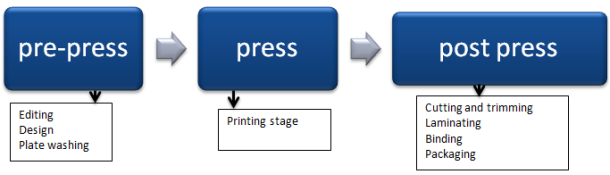
The production process of student textbooks consists of three key stages: pre-press, press, and post-press, each involving critical activities to ensure the final product meets quality standards. In the pre-press stage, the process begins with the preparation of text and images, which involves gathering and formatting manuscripts and illustrations using desktop publishing software. This is followed by typesetting, where the text and images are arranged into a visually appealing layout, determining font styles, sizes, and spacing for readability. A thorough proofreading occurs to correct any errors, while color management tools are used to ensure consistent color representation. Once finalized, the layout is transferred to printing plates, often through advanced CTP technology.
During the press stage, the prepared plates are mounted on the printing press, where the actual printing takes place. The paper is fed through the press, and inks are applied to transfer the text and images onto the paper. Continuous quality control is essential during this phase to monitor color accuracy and print quality, with adjustments made as necessary. After printing, the ink requires drying, which can vary depending on the ink type and may involve methods like UV drying for quicker results.
The post-press activities commence with trimming the printed sheets to the desired textbook size, followed by binding, where the trimmed pages are securely held together using methods such as perfect binding for paperbacks or case binding for hardcovers. The covers are printed, trimmed, and attached to the bound pages, often undergoing additional processes like laminating to enhance durability and appearance. A final quality inspection ensures that the textbooks meet the required standards in print quality and binding strength. Finally, the completed textbooks are packaged for distribution, which can include bundling, labeling, and preparing shipments for educational institutions or retailers. Each stage of this process is essential to producing high-quality student textbooks that are both functional and visually appealing for educational purposes.
Figure 1. Student Textbook Printing Process.Student Textbook Printing Process.
2.5. Value Chain of Printing Industry
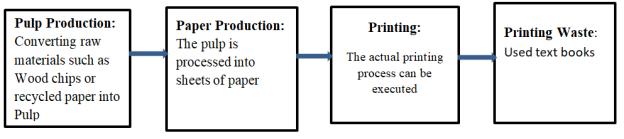
Quality issues in one stage that can create a feedback loop affecting subsequent stages. For instance, if the paper produced is of low quality, the printing process will suffer, leading to increased waste and customer dissatisfaction.
Figure 2. Value Chain of Pulp, Paper and Printing.
2.6. SWOT Analysis for the Printing Industry in Ethiopia
Strengths
The local printing industry has an estimated capacity to produce approximately 158 million textbooks annually, which can cater to significant educational demands. The industry currently employs over 5,000 individuals, contributing to job creation and community investment. There is potential for technology transfer and the use of modern printing methods, which can improve quality and competitiveness. Locally produced textbooks eliminate import costs, conserving foreign currency and promoting economic self-sufficiency.
Weaknesses
Many printing industries operate with obsolete machinery, limiting production capacity and quality. There is a gap in vocational training and a lack of awareness about careers in printing, resulting in a shortage of qualified professionals. Local printing firms often lack the necessary working capital for funding for modernization. Reliance on imported raw materials can lead to price volatility and production delays, affecting competitiveness.
Opportunities
The Increased demand for locally produced textbooks can significantly boost sales and expand market growth potential as educational enrollment rises along with the population. Investing in advanced printing technologies can enhance the quality and efficiency of production, making local firms more competitive against international suppliers. The increasing school population and demand for consumer goods that utilize printed material in packaging create a larger customer base, expanding the industry’s market potential. Improving literacy rates contribute to an increased demand for reading materials, further driving the need for textbooks and educational resources. And there is a significant opportunity for businesses that invest in high-level printing equipment, enabling them to offer innovative and quality products to their customers.
Threats
International suppliers often offer better products at lower prices due to advanced technology, posing a significant threat to local printers. Broader economic conditions, regional instabilities, and fluctuating exchange rates can impact market dynamics and investment decisions. The absence of supportive policies can hinder growth opportunities and the sector's ability to innovate and adapt. Changes in global market dynamics can alter demand patterns, complicating planning and production for local firms.
3. Product Analysis and Economic Significance of the Sector
3.1. Product Analysis of the Sector
3.1.1. Product User Analysis
Student textbooks are vital instructional tools that facilitate learning at all academic levels. By offering structured information, explanations, activities, and visuals that aid students in better understanding difficult subjects, they play a critical part in the educational process. Not only do students use these textbooks, but teachers often find them to be useful resources for lesson planning and instruction. Additionally, textbooks are frequently used by student families to help with homework and reinforce lessons learned at home. All things considered, textbooks are an essential part of education, encouraging reliability and excellence in educational experiences.
3.1.2. Price Analysis and Factors for Price Increment
The high price of local student textbooks can be attributed to several correlated factors
| [14] | Zenkin, M., Makatora, D., Makatora, A. “The Analysis of Printing Equipment Manufacturing.” 2022, pp. 69-72. |
[14]
. Rising raw material costs, particularly for paper and printing supplies, have significantly increased production expenses. Additionally, currency depreciation has further exacerbated the situation, as a weakening local currency escalates import costs for essential materials. Tax and regulatory issues also play a crucial role; burdensome taxation and complex regulations can hinder production efficiency and inflate costs. Market fluctuations contribute to pricing instability, with variability in supply and demand affecting the overall pricing structure. Moreover, extended printing timelines due to production delays often lead to increased costs, compounding the issue. The lack of competition, characterized by a limited number of suppliers in the market, allows prices to remain high, as there are fewer options for consumers
| [15] | “Publishing Business vs the Internet: How Has the World Wide Web Affected the Economics and Marketing of Printing Companies?” University Economic Bulletin. 2025, 20(1).
https://doi.org/10.69587/ueb/1.2025.40 |
[15]
. Finally, distribution challenges, including inefficiencies in logistics, further elevate the overall costs associated with delivering textbooks to students. Addressing these multifaceted issues is essential for creating a more sustainable and affordable textbook market.
3.1.3. Quantity, Quality and Production Time of Textbook
In Ethiopia, the production of textbooks involves several key factors: quantity, quality and production time
| [11] | Kulkarni, V. D. “Role of Technology in Developing Indian Print Industry.” International Journal of Information Technology and Management. 2021, 16(1), 1-7. |
[11]
. The number of textbooks needed is influenced by the student population and educational reforms. Publishers often conduct large print runs to meet the needs of schools, which can vary from year to year. Textbooks must align with the national curriculum and educational standards. Factors include the use of durable materials, clear printing, and effective illustrations. Quality assurance processes are essential to maintain educational standards.
Most of The time, the durations of publications that given for local printing Industries are more short. But this must be considered to support local Publishers. Because, the outsource student text books take more time than local publications.
3.2. Economic Significance of the Sector
3.2.1. Job Creation
Ethiopian printing industry plays a significant role in job creation, contributing to the local economy and offering diverse employment opportunities for 5004 Ethiopians only in one shift of production process. By addressing challenges and investing in the sector, Ethiopia can enhance job opportunity and skill development in the industry. This includes: graphic designers, printers, bindery workers, and quality control personnel. And also, indirect jobs arise in areas such as logistics, marketing, and sales, contributing to broader economic activity.
3.2.2. Import Substitution and Saving Foreign Currency
Import substitution and saving foreign currency through printing industry in Ethiopia are essential strategies for enhancing economic self-sufficiency and resilience
| [9] | Gyamfi, F. D. “The Triple Bottom Line of Printing Enterprises in Accra: Evaluating Economic Performance, Environmental Sustainability and Social Responsibility.” Journal of African Arts & Culture. 2025, 8(1), 77-109.
https://doi.org/10.63102/jaac.v8i1.20254 |
[9]
. By producing textbooks, packaging, and other printed materials locally, Ethiopia can reduce reliance on imported goods and saves foreign currency. This is particularly important for educational materials that are essential for the country's development. Printing industry can expand into various products, including newspapers, magazines, and marketing materials, which have traditionally been imported
.
Import substitution helps save foreign currency that would otherwise be spent on importing printed Text books. This can be redirected towards other critical sectors of the economy. Local production can lead to lower prices for consumers, making goods more affordable and accessible.
3.2.3. Technology Transfer by the Sector
Technology transfer in Ethiopian printing industry is important for modernizing operations, enhancing productivity and improving product quality. Introducing state-of-the-art printing machinery, such as digital printers and automated presses can significantly enhance production efficiency and quality. Utilizing modern design and production software improves work flow and allows for better management of printing industries
| [17] | Garrison, D. R. “Role of Instructional Technology in the Transformation of Higher Education.” Educational Technology Research and Development. 2017, 65(1), 133-144. https://doi.org/10.1007/s11423-016-9498-8 |
[17]
.
Technology transfer often includes training programs for local workers, enabling them to operate new machinery and software effectively. Ongoing education in the latest printing techniques and technologies helps maintain a skilled workforce that can adapt to industry changes. Collaborating with foreign skilled manpower can facilitate technology transfer through joint ventures and partnerships, bringing in expertise and best practices. International firms can provide insights into efficient production processes, quality control, and market trends.
3.2.4. Export Opportunities
The Ethiopian printing industry has significant potential for export opportunities. Ethiopian textbook printing industry holds considerable potential for export growth by tapping into regional demands, focusing on quality sustainability and leveraging technology. By addressing these opportunities, the industry can expand and contribute significantly to educational development both locally and internationally. Investing in modern printing technologies and adhering to international quality standards, Ethiopian printers can produce competitive products for export.
3.2.5. Revenue Generation
Ethiopian printing industry has significant potential for revenue generation and driving by various factors including market demand and technological advancements
| [18] | Zakari, M. “The Relationship Between Corporate Social Responsibility and Profitability: The Case of Dangote Cement Plc.” Journal of Finance and Accounting. 2017, 5(4), 171.
https://doi.org/10.11648/j.jfa.20170504.18 |
[18]
. However, companies must navigate challenges such as competition and material costs to optimize their revenue streams. In the last four years, Ethiopian Printing Industries were produced 725,009,510 ton of Student Text Books and sold to 4,460,092,239 ETB per year. This indicates, as they produce under their production capacity.
4. Challenges
4.1. Technology and Infrastructure Challenges
Outdated Machinery
The reliance on dated printing technology significantly restricts production capabilities. Many local printing companies utilize older machinery that cannot keep pace with modern production demands. This situation leads to longer production cycles and results in inferior quality compared to international standards. Furthermore, these outdated systems are often less efficient, consuming more resources and time for maintenance.
Insufficient Local Suppliers
Businesses in the local printing sector frequently encounter difficulties sourcing parts and machinery repairs locally. The gap in the supply chain for high-quality printing technology means printers struggle to maintain operations efficiently and to (re) invest in essential equipment. This reliance on international suppliers can lead to delays and increased costs.
Need for Investment
To compete effectively on both local and international fronts, there is a pressing need for investment in modern printing technologies. Upgrading machinery could significantly enhance production speed and quality. However, without access to affordable financing options, many firms find it difficult to make these investments, thereby limiting their growth potential.
Training Gaps
There is often a disconnect between the technologies being employed and the workforce's skill sets. Continuous professional development and training programs in emerging printing technologies are essential. When staffs are inadequately trained in modern practices, their productivity suffers, impacting the overall efficiency of the operation.
4.2. Skilled Human Resources Availability Challenges
Skills Shortage
One of the most pronounced challenges in the printing industry in Ethiopia is the shortage of skilled labor. Many potential employees lack the specialized technical expertise needed to operate modern printing equipment or to understand advanced production processes.
Insufficient Training Opportunities
While some educational institutions may offer programs related to printing technology, these programs often do not provide the practical, hands-on experience necessary to meet industry requirements. Additionally, there is a lack of partnerships between printing companies and educational institutions which could facilitate better training and understanding of industry needs.
High Turnover Rates
The printing industry often experiences high employee turnover, especially among skilled workers. This is attributed to better job offers in other industries, such as technology and telecommunications. When skilled employees leave, the industry incurs additional costs to hire and train new personnel, further straining resources.
Need for Partnerships with Educational Institutions
Creation of formal partnerships with technical schools and universities could greatly enhance the skill set within the local labor market. Such efforts would ensure a pipeline of trained professionals ready to meet the demands of the printing industry, aiding in workforce stability and capability.
4.3. Market Factors
Strong Demand vs. Quality Issues
Ethiopia's market demonstrates a strong appetite for locally produced textbooks, but the ability to meet this demand with quality products is lacking. Imported textbooks often provide higher quality and reliability, creating a perception that discredits local businesses. This can deter local buyers from investing in domestic products.
Import Competition
Local printing firms consistently face competition from cheaper imported goods. Imported textbooks benefit from economies of scale, which local printers cannot achieve due to their operating scale and cost structures. This competitive disadvantage can lead to market share losses, substantially affecting profitability.
Pricing Barriers
Import duties on raw materials combined with the overall cost of production elevate the pricing of domestically produced textbooks. This makes it more difficult for local printers to compete with imported products, thus stifling their market presence. If local printers do not find ways to reduce costs or enhance their value propositions, they risk further marginalization in the marketplace.
4.4. Raw Materials Availability Challenges
Limited Local Suppliers
Local printing companies often encounter challenges in securing quality raw materials, such as paper and ink, from local suppliers. This scarcity can disrupt production schedules and hinder timely delivery of products. Furthermore, when raw materials must be imported, the costs increase, putting additional financial strain on printers.
High Import Costs
The requirement to source raw materials internationally not only increases production costs but can also lead to greater price volatility. Currency fluctuations, changes in international trade policies, and other factors can further complicate procurement strategies and lead to unpredictability in production costs.
Price Fluctuations
The pricing of raw materials can vary significantly, affecting price stability within the printing sector. Such variations complicate financial forecasting and budgeting for local businesses. Without strategic sourcing or contingency plans, these fluctuations can adversely impact profit margins.
4.5. Financial Challenges
Access to Financing
Local printing companies often struggle to secure financing due to perceptions of high risk associated with the sector. Lack of collateral or poor credit history makes it challenging for them to acquire loans necessary for operations or expansion. This financial barrier significantly limits the ability to invest in improvements or adaptations.
Currency Fluctuations
Fluctuating currency exchange rates can complicate the costs associated with imported materials, making budgeting and financial planning more challenging. Printers may face unforeseen increases in costs that can erode profitability and financial stability.
Inability to Compete
Financial constraints limit local printers’ ability to compete effectively against imported products, leading to a cycle of dependency on foreign materials. This dependence hampers growth, innovation, and further investment into local capacity.
4.6. Policy and Support Challenges
Lack of Favorable Policies
Current government policies do not sufficiently support the domestic printing and publishing industry. The absence of incentives, subsidies, or grants tailored to local printing firms restricts opportunities for growth and investment.
Regulatory Framework Issues
An unclear regulatory environment can create uncertainty and may dissuade both domestic and foreign investment in the printing sector. Complex bureaucratic processes can slow down business operations and affect compliance costs.
Need for Support Programs
The absence of targeted support programs from government or industry associations hinders the capacity of local printing firms to develop and thrive. Initiatives that could foster innovation, provide financial assistance, or facilitate access to technology and training are urgently needed.
Communication Gaps
Improved communication between the government and the printing sector could help cultivate collaborative efforts to address industry challenges. Effective dialogue can lead to a better understanding of the sector's needs, informing policy decisions that facilitate growth.
4.7. Not Being Treated as Manufacturer (Rather as Service) and Lack of Gov’T Institutional Support
The classification of Ethiopia's printing industry as a service sector rather than a manufacturing sector has significant negative implications for its development and sustainability
| [19] | Mamo, Y. A., Sisay, A. M., Dessalegn, B., Angaw, K. W. “The Socio-economic Effect of Corporate Social Responsibility on Local Community Development in Southern Ethiopia.” Cogent Business and Management. 2023, 10(1), 1-22.
https://doi.org/10.1080/23311975.2022.2159749 |
[19]
. This perception limits government support, denying the industry access to crucial financial assistance such as grants and subsidies essential for modernization and innovation. Consequently, printing companies may struggle to secure funding for necessary technological upgrades, leading to inferior product quality and diminished competitiveness. Additionally, the lack of tailored policies and strategic planning further exacerbates the industry's challenges, while insufficient investment in vocational training exacerbates workforce skill gaps. Ultimately, this misclassification risks the sector's growth, increasing reliance on imported materials and undermining local job creation and economic development. There is a noticeable lack of government attention toward the printing industry, as there is no specific department dedicated to it within the Ministry of Industry or the Manufacturing Industry Development Institute. Instead, the existing focus is on the Pulp, Paper, and Packaging Department, which does not encompass the printing sector. This oversight highlights the need for greater recognition and support for the printing industry, which is crucial for its growth and sustainability.
4.8. Lack of Industry Classification, Standards and Grading System for Student Textbook
The lack of a proper classification system and standardized grading for student textbooks hampers both quality assurance and fair competition within the industry
. The multitude of small and medium-sized printing firms has made it challenging to establish uniform classification and quality standards. Consequently, this absence has led to a diminished sensitivity to quality, excellence, and competitiveness. While the Ethiopian Standards institute (ESI) maintains a technical committee and work plan for "paper, and board," it does not extend its efforts to cover the printing and publishing sectors. This oversight indicates a gap in the regulatory framework that is critical for ensuring high standards in printing.
5. Conclusions and Recommendation
5.1. Conclusions
The evaluation of the Ethiopian printing industry reveals its crucial role in advancing the country’s educational and economic landscape. Currently, the local printing sector employs over 5,000 individuals, significantly contributing to job creation. This sector exhibits an estimated local production capacity of approximately 158 million textbooks annually, highlighting its potential to meet educational demands effectively.
By investing in modern technologies, which could involve the adoption of advanced printing machinery, the industry can significantly enhance its operational capabilities. This shift is vital, as the country continues to spend around $35.78 million annually on importing textbooks, emphasizing the need for self-sufficiency that conserves foreign currency and fosters local job opportunities. Each locally produced textbook represents potential savings through reduced import costs and promotes the development of local talent, thereby enhancing economic resilience.
The Ethiopian printing industry has produced an estimated 2,900,038,043 tons of student textbooks over the past four years, generating revenues amounting to approximately 17,840,368,958 ETB. Therefore, local printing industry should get attention from government to publish and print student textbook according to the potential of the companies so as to play their role in job creation and foreign currency saving.
5.2. Recommendation
Based on the evaluation of the Ethiopian printing industry and its potential for growth and self-sufficiency in textbook production, the following recommendations are proposed:
1) To publish student textbooks locally the involvement of students, educators, publishers, governments, and technology providers are important.
2) Input output coefficients should be conducted for raw materials used for textbook printers.
3) Government should reduce import taxes and tariffs on raw materials used in the printing of student textbooks.
4) Enough delivery time should be given for local printers.
5) Standard should be prepared for student textbooks.
6) From annual student textbook need the government should give in percent for local industries.
7) Invest in local paper manufacturing company to improve paper quality and printing technology to reduce reliance on expensive foreign printing.
8) Encouraging local publishers to develop affordable, high-quality textbooks according to quality specifications.
Abbreviations
CTP | Computer to Plate |
UV | Ultra-Violate |
SWOT | Strength Weakness Opportunity Treats |
MoE | Ministry of Education |
Author Contributions
Sisay Demissie Geda: Conceptualization, Resource, Software, Methodology, Investigation, Resources, Writing – Original draft, Formal Analysis
Tujuba Tamiru Ashetu: Supervision, Validation, Formal Analysis, Software, Project administration, Writing – review & editing
Conflicts of Interest
The authors declare no conflicts of interest.
References
| [1] |
Almakaty, S. S. “History and Development of Printing Industry in Saudi Arabia: Review and Discussion.” International Journal of Media, Journalism and Mass Communications. 2024, 10(1), 65-72.
https://doi.org/10.20431/2454-9479.1001006
|
| [2] |
Hucadinota, L., Amri, A., Farani, D. B., Azly, N., Ali, M. “The Challenges and Strategies of Printing Industry.” 2022.
https://doi.org/10.4108/eai.16-11-2022.2326107
|
| [3] |
Mtshali, E. P., Nyakala, K. S., Munyai, T. T. “Identifying Causes of Low Productivity in the Printing Industry.” 2018, pp. 933-944.
|
| [4] |
Liu, Y., Li, F., Zhao, D., Tao, J. “Digital Printing Helps Printers to Transform and Develop: A Study of 8 Printers Around Beijing, Tianjin, and Hebei.” Proceedings of the 2023 3rd International Conference on Financial Management and Economic Transition (FMET 2023). Atlantis Press, 2023.
https://doi.org/10.2991/978-94-6463-272-9_16
|
| [5] |
Mathews, B. “Dynamics of Networking: A Case Study of Printing Industry in Kerala.” Business Economics. 2019, 6(6), 673-675.
|
| [6] |
Gebrewolde, T. M., Rockey, J. “The Effectiveness of Industrial Policy in Developing Countries: Causal Evidence from Ethiopian Manufacturing Firms.” Journal of Development Effectiveness. 2022, 00(00), 1-27.
https://doi.org/10.1080/19439342.2022.2090997
|
| [7] |
Gebrehiwot, B. A. “Industrial Policy and Structural Transformation in Ethiopia.” 2022.
|
| [8] |
Krishnaswamy, N. “A Study on the Effect of Population Growth on Printing Industry in India.” International Journal of Advanced Multidisciplinary Research and Studies. 2025, 5(5), 1210-1214.
https://doi.org/10.62225/2583049X.2025.5.5.5097
|
| [9] |
Gyamfi, F. D. “The Triple Bottom Line of Printing Enterprises in Accra: Evaluating Economic Performance, Environmental Sustainability and Social Responsibility.” Journal of African Arts & Culture. 2025, 8(1), 77-109.
https://doi.org/10.63102/jaac.v8i1.20254
|
| [10] |
Latif, N. A., Azly, N., Ali, M. “Skilled Workers Shortages in the Printing Industry: Perspectives from Industry Experts.” International Journal of Entrepreneurship and Management Practices. 2025.
https://doi.org/10.35631/IJEMP.728029
|
| [11] |
Kulkarni, V. D. “Role of Technology in Developing Indian Print Industry.” International Journal of Information Technology and Management. 2021, 16(1), 1-7.
|
| [12] |
Masod, M. Y., Zakaria, S. F., Author, C. “Redefining Malaysia’s Printing Landscape: Insights from Porter’s.” 2024, 19(1).
|
| [13] |
Priya, K. S. “Impact of Technological Upgradation on Printing Units in Virudhunagar District.” International Journal of Multidisciplinary Research and Development. 2018, 5(2), 960-963.
|
| [14] |
Zenkin, M., Makatora, D., Makatora, A. “The Analysis of Printing Equipment Manufacturing.” 2022, pp. 69-72.
|
| [15] |
“Publishing Business vs the Internet: How Has the World Wide Web Affected the Economics and Marketing of Printing Companies?” University Economic Bulletin. 2025, 20(1).
https://doi.org/10.69587/ueb/1.2025.40
|
| [16] |
Davis, R. H. “Business Economics and the Printing Industry.” Business Economics. 2014, 49(2), 122-126.
https://doi.org/10.1057/be.2014.9
|
| [17] |
Garrison, D. R. “Role of Instructional Technology in the Transformation of Higher Education.” Educational Technology Research and Development. 2017, 65(1), 133-144.
https://doi.org/10.1007/s11423-016-9498-8
|
| [18] |
Zakari, M. “The Relationship Between Corporate Social Responsibility and Profitability: The Case of Dangote Cement Plc.” Journal of Finance and Accounting. 2017, 5(4), 171.
https://doi.org/10.11648/j.jfa.20170504.18
|
| [19] |
Mamo, Y. A., Sisay, A. M., Dessalegn, B., Angaw, K. W. “The Socio-economic Effect of Corporate Social Responsibility on Local Community Development in Southern Ethiopia.” Cogent Business and Management. 2023, 10(1), 1-22.
https://doi.org/10.1080/23311975.2022.2159749
|
Cite This Article
-
APA Style
Geda, S. D., Ashetu, T. T. (2025). Providing Detail Overview of the Ethiopian Printing Industry, Including the Number of Active Publishers, Job Opportunities, and Market Condition. Research and Innovation, 2(1), 29-41. https://doi.org/10.11648/j.ri.20260201.14
 Copy
|
Copy
|
 Download
ACS Style
Geda, S. D.; Ashetu, T. T. Providing Detail Overview of the Ethiopian Printing Industry, Including the Number of Active Publishers, Job Opportunities, and Market Condition. Res. Innovation 2025, 2(1), 29-41. doi: 10.11648/j.ri.20260201.14
Copy
|
Download
AMA Style
Geda SD, Ashetu TT. Providing Detail Overview of the Ethiopian Printing Industry, Including the Number of Active Publishers, Job Opportunities, and Market Condition. Res Innovation. 2025;2(1):29-41. doi: 10.11648/j.ri.20260201.14
Copy
|
Download
-
@article{10.11648/j.ri.20260201.14,
  author = {Sisay Demissie Geda and Tujuba Tamiru Ashetu},
  title = {Providing Detail Overview of the Ethiopian Printing Industry, Including the Number of Active Publishers, Job Opportunities, and Market Condition},
  journal = {Research and Innovation},
  volume = {2},
  number = {1},
  pages = {29-41},
  doi = {10.11648/j.ri.20260201.14},
  url = {https://doi.org/10.11648/j.ri.20260201.14},
  eprint = {https://article.sciencepublishinggroup.com/pdf/10.11648.j.ri.20260201.14},
  abstract = {The local printing industry is integral to the global economy, particularly in sectors like education and media. Despite its potential, the industry faces significant challenges that hinder growth and efficiency. With a local production capacity of approximately 158 million textbooks, there is a compelling opportunity to reduce dependency on imported materials, which currently costs around $35.78 million annually. This financial drain not only affects foreign currency reserves but also limits local job creation and stifles technological innovation. The local printing sector could increase employments from 5,000, to 7,506, if the text books printing allowed locally. This growth would not only empower communities economically but also foster technology transfer, helping local firms remain competitive in the global market. However, many businesses struggle due to outdated technology and infrastructure, which restricts production capacity and product quality. Additionally, attracting skilled labor is a notable challenge, exacerbated by a lack of vocational training and awareness of career opportunities in printing Industries. Market uncertainties, compounded by fluctuating raw material prices and insufficient financial resources, further inhibit competitiveness. The absence of comprehensive government policies to support the local printing Industry sector significantly limits growth potential. A thorough assessment of the industry's capability to meet educational demands is crucial for identifying operational strengths and critical issues. Addressing these challenges can lead to a more resilient local printing industry that contributes to educational sustainability and broader economic development.},
 year = {2025}
}
Copy
|
Download
-
TY  - JOUR
T1  - Providing Detail Overview of the Ethiopian Printing Industry, Including the Number of Active Publishers, Job Opportunities, and Market Condition
AU  - Sisay Demissie Geda
AU  - Tujuba Tamiru Ashetu
Y1  - 2025/12/26
PY  - 2025
N1  - https://doi.org/10.11648/j.ri.20260201.14
DO  - 10.11648/j.ri.20260201.14
T2  - Research and Innovation
JF  - Research and Innovation
JO  - Research and Innovation
SP  - 29
EP  - 41
PB  - Science Publishing Group
SN  - 3070-6297
UR  - https://doi.org/10.11648/j.ri.20260201.14
AB  - The local printing industry is integral to the global economy, particularly in sectors like education and media. Despite its potential, the industry faces significant challenges that hinder growth and efficiency. With a local production capacity of approximately 158 million textbooks, there is a compelling opportunity to reduce dependency on imported materials, which currently costs around $35.78 million annually. This financial drain not only affects foreign currency reserves but also limits local job creation and stifles technological innovation. The local printing sector could increase employments from 5,000, to 7,506, if the text books printing allowed locally. This growth would not only empower communities economically but also foster technology transfer, helping local firms remain competitive in the global market. However, many businesses struggle due to outdated technology and infrastructure, which restricts production capacity and product quality. Additionally, attracting skilled labor is a notable challenge, exacerbated by a lack of vocational training and awareness of career opportunities in printing Industries. Market uncertainties, compounded by fluctuating raw material prices and insufficient financial resources, further inhibit competitiveness. The absence of comprehensive government policies to support the local printing Industry sector significantly limits growth potential. A thorough assessment of the industry's capability to meet educational demands is crucial for identifying operational strengths and critical issues. Addressing these challenges can lead to a more resilient local printing industry that contributes to educational sustainability and broader economic development.
VL  - 2
IS  - 1
ER  -
Copy
|
Download





 Share This Article
 Twitter
 Linked In
 Facebook