
Given the importance and necessity of branding in the clothing industry, this research was conducted with the aim of developing clothing brands in online businesses. This research is applied in terms of purpose and descriptive-survey in terms of method, and it has adopted a mixed (qualitative-quantitative) approach. In the first step of qualitative research, the method used was meta-analysis, and the statistical population included studies, books, and articles from 2014 to 2024 in the field of clothing brand development in online businesses, including works published in reputable scientific and promotional journals in this period. In the second step, the quantitative research method was used using confirmatory factor analysis and the statistical population included 238 senior and middle managers of clothing manufacturing companies in Mazandaran, of which a sample of 147 was determined using the Cochran formula. In the qualitative stage, meta-analysis was used, and in the quantitative stage, PLS structural equation modeling was used. The findings identify five main dimensions: brand strategy, design and visual variables, competitive advantage, content production and feedback, and communication, each of which includes specific components. The relationships between dimensions and components were verified through path analysis, validating the proposed model. The overall fit of the model, calculated using the GOF formula, indicates a strong fit. This study provides practical insights into the strategic development of apparel brands in online markets, enhancing brand competitiveness, and customer engagement.
| Published in | Research and Innovation (Volume 1, Issue 1) |
| DOI | 10.11648/j.ri.20250101.18 |
| Page(s) | 56-70 |
| Creative Commons |
This is an Open Access article, distributed under the terms of the Creative Commons Attribution 4.0 International License (http://creativecommons.org/licenses/by/4.0/), which permits unrestricted use, distribution and reproduction in any medium or format, provided the original work is properly cited. |
| Copyright |
Copyright © The Author(s), 2025. Published by Science Publishing Group |
Brand Development, Online Business, Apparel Industry, Meta-Analysis
Row | Researcher/Year | Title | Result |
|---|---|---|---|
1 | [23] | The model of new product development in the Iranian fashion and apparel industry | The seven-stage model of new product development in the fashion and apparel industry includes the stages: design, product engineering, material sourcing, production, marketing, market launch, and product success monitoring. |
2 | [18] | Identifying the dimensions and components of digital marketing tools in startups active in the fashion and apparel industry in Iran | In order to successfully implement digital marketing in Iranian fashion and apparel startups and achieve success, organizational factors, innovation - competitive advantage, business factors - profitability, and also 12 extracted components are of high importance. |
3 | [ 3] | A review of sustainability and development factors in Iran's textile and apparel industry | Raising awareness among fashion designers and manufacturers about sustainable development, which plays an important role in the application of sustainable development principles in the country. One of the strategies that can be offered in this regard is the optimal use of clothing in the best possible way. Buying clothes that are of high quality and durability can be the best solution. |
4 | [ 4] | Identification and ranking of components for creating sustainable development in the clothing industry of Shahr-e Kord city | The factor of technology and information technology infrastructure received the highest rank, while the factor of social commitment received the lowest rank. Based on the obtained result. to achieve organizational productivity, managers should pay attention to the sustainable development factor in the sustainable development of the apparel industry. |
5 | [3] | Infrastructure factors influencing the future management and development of Iran's clothing industry | Three components and 22 sub-components were prioritized as follows: a) reforming existing structures b) completing the apparel industry chain c) promoting behavioural patterns: infrastructure, apparel industry. Text to translate: Textiles, future management, development |
6 | [24] | Research on the current status and development trends of adaptive clothing demand | Clothing companies in some countries, including the United States, the United Kingdom, Australia, Russia, and others... With a complete range of clothing and regular production and sales, they have developed and formed. The systematic development and research of adaptive clothing for the care of disabled groups, promoting social harmony, opening up potential clothing markets, creating economic benefits, and improving the happiness index of people are of great importance. |
7 | [10] | The state of art in the relationship between sustainability, the fashion industry, and sustainable business models | Many technologies, best practices, and innovations exist with the aim of making the fashion industry less impactful and, most importantly, circular. Therefore, some key findings for each of the three areas under review are examined in depth, considering that the companies and sectors involved sometimes have unique characteristics and features, so results cannot be uniformly applied to every business model. |
8 | [21] | The impact of information and communication technology on the retail industry: changes in online clothing shopping | Determining the changes in the impact of such demographic and economic factors on the online shopping behaviour of European consumers for clothing, such as gender, age, education level, employment status, disposable income, consumer spending, and online clothing purchases. The results obtained from the conducted study are useful for describing the change in behaviour and attitude towards online clothing shopping in the European Union. |
9 | [22] | The impact of social media entrepreneurship on sustainable development: Evidence from online clothing stores in Bangladesh | Bangladesh is capable of creating job opportunities for rural women through ICT initiatives. Consistently, this study also proves that entrepreneurship on social media increases women's share of their family's income. |
10 | [19] | An experimental study on consumer preferences for an online custom clothing platform. | Unlike traditional offline shopping experiences, customers who engage in online shopping are not able to physically interact with the products they intend to purchase. As a result, a comprehensive and accurate display of product information plays a key role in facilitating the online shopping experience in fashion. |
11 | [5] | Identifying the dimensions and components of digital marketing tools in startups active in the fashion and apparel industry in Iran | In order to successfully implement digital marketing in Iranian fashion and apparel startups and achieve success, organizational factors, innovation - competitive advantage, business factors - profitability, and also 12 extracted components are of high importance |
The meaning of effect size | Amount of r | Amount of d |
|---|---|---|
Small effect size | Less than 0.3 | Less than 0.5 |
Medium effect size | From 0.3 to 0.5 | From 0.5 to 0.8 |
Large effect size | More than 0.5 | More than 0.8 |
Categorization of variables | Obtained variables | Number | Percentage of 32 studies (%) |
|---|---|---|---|
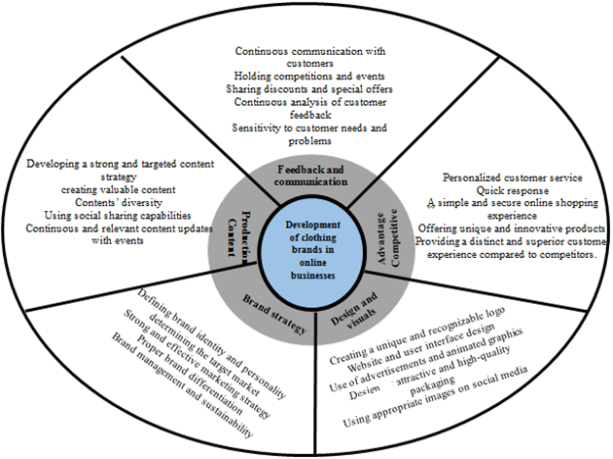
Brand strategy | Determining brand identity and personality | 19 | 59/37 |
Target market determination | 21 | 65/62 | |
Strong and effective marketing strategy | 26 | 81/25 | |
Proper brand segmentation | 18 | 56/25 | |
Brand management and sustainability | 20 | 62/50 | |
Design and visuals | Creating a unique and recognizable logo | 25 | Dec-78 |
Website and user interface design | 24 | 75 | |
Use of advertisements and animated graphics | 26 | 81/25 | |
Attractive and high-quality packaging design | 28 | 87/50 | |
Using appropriate images on social media | 24 | 75 | |
Competitive advantage | Personalized customer services | 18 | 56/25 |
Quick response | 16 | 50 | |
A simple and secure online shopping experience | 14 | 43/75 | |
Offering unique and innovative products | 21 | 65/62 | |
Providing a distinct and superior customer experience compared to competitors | 22 | 68/75 | |
Content creation | Developing a strong and targeted content strategy | 28 | 87/50 |
Creating valuable content | 19 | 59/37 | |
Content diversity | 13 | 40/62 | |
Using social sharing features | 8 | 25 | |
Continuous and timely updates of content in line with events | 25 | Dec-78 | |
Feedback and communications | Continuous communication with customers | 17 | Dec-53 |
Holding competitions and events | 10 | 31/25 | |
Sharing discounts and special offers | 16 | 50 | |
Continuous analysis of customer feedback | 21 | 65/62 | |
Sensitivity to customer needs and problems | 16 | 50 |
Effect size magnitude | Effect size magnitude | Chi-square | Significance percentage | |||
|---|---|---|---|---|---|---|
Under 0.1 | Under 0.3 | Between 3.0 and 5.0 | Between 3.0 and 5.0 | |||
Without impact | Less | Average | A lot | |||
Abundance | 0 | 1 | 7 | 24 | 231/65 | 0/001** |
Effect size r | Lower bound | Upper bound | Z value | Q statistic | Degrees of freedom | P value | |
|---|---|---|---|---|---|---|---|
Permanent effect | 0/29 | 0/30 | 0/42 | 282/34 | 1523/08 | 31 | 0/001 |
Random effect | 0/41 | 0/36 | 0/51 | 18/91 |
Categorization of variables | Obtained variables | Number | Fixed combined effects | Confidence interval of fixed effects | Random effects | Confidence interval of random effects | Homogeneity test |
|---|---|---|---|---|---|---|---|
Brand strategy variables | Determining brand identity and personality | 19 | 0/60* | 0/60 - 0/70 | 0/77* | 0/70 - 0/80 | 29/20* |
Target market determination | 21 | 0/65* | 0/60 - 0/70 | 0/80* | 0/70 - 0/80 | 83/11* | |
Strong and effective marketing strategy | 26 | 0/77* | 0/70 - 0/80 | 0/85* | 0/80 - 0/90 | 96/36* | |
Proper brand differentiation | 18 | 0/59* | 0/50 - 0/60 | 0/75* | 0/70 - 0/80 | 97/02* | |
Brand management and sustainability | 20 | 0/62* | 0/60 - 0/70 | 0/79* | 0/70 - 0/80 | 121/15* | |
Design and visual variables | Creating a unique and recognizable logo | 25 | 0/71* | 0/70 - 0/80 | 0/65* | 0/60 - 0/70 | 69/47* |
Website and user interface design | 24 | 0/68* | 0/60 - 0/70 | 0/60* | 0/60 - 0/70 | 91/09* | |
Use of advertisements and animated graphics | 26 | 0/75* | 0/70 - 0/80 | 0/67* | 0/60 - 0/70 | 86/31* | |
Attractive and high-quality packaging design | 28 | 0/79* | 0/70 - 0/80 | 0/69* | 0/60 - 0/70 | 66/01* | |
Using appropriate images on social media | 24 | 0/67* | 0/60 - 0/70 | 0/61* | 0/60 - 0/70 | 93/91* | |
Competitive advantage variables | Personalized customer services | 18 | 0/62* | 0/60 - 0/70 | 0/69* | 0/60 - 0/70 | 78/05* |
Quick response | 16 | 0/60* | 0/60 - 0/70 | 0/66* | 0/60 - 0/70 | 96/61* | |
A simple and secure online shopping experience | 14 | 0/59* | 0/50 - 0/60 | 0/61* | 0/60 - 0/70 | 86/31* | |
Offering unique and innovative products | 21 | 0/65* | 0/60 - 0/70 | 0/70* | 0/60 - 0/70 | 66/45* | |
Providing a distinct and superior customer experience compared to competitors | 22 | 0/67* | 0/60 - 0/70 | 0/72* | 0/70 - 0/80 | 21/19* | |
Content production variables | Developing a strong and targeted content strategy | 28 | 0/81* | 0/80 - 0/90 | 0/85* | 0/80 - 0/90 | 96/30* |
Creating valuable content | 19 | 0/73* | 0/70 - 0/80 | 0/69* | 0/60 - 0/70 | 75/34* | |
Content diversity | 13 | 0/68* | 0/60 - 0/70 | 0/63* | 0/60 - 0/70 | 91/04* | |
Using social sharing features | 8 | 0/30* | 0/20 - 0/30 | 0/33* | 0/30 - 0/40 | 85/66* | |
Continuous and timely updates of content with events | 25 | 0/79* | 0/70 - 0/80 | 0/76* | 0/70 - 0/80 | 52/13* | |
Feedback and communication variables | Continuous communication with customers | 17 | 0/65* | 0/60 - 0/70 | 0/67* | 0/60 - 0/70 | 57/18* |
Holding competitions and events | 10 | 0/44* | 0/30 - 0/40 | 0/35* | 0/30 - 0/40 | 80/31* | |
Sharing discounts and special offers | 16 | 0/63* | 0/60 - 0/70 | 0/68* | 0/60 - 0/70 | 94/25* | |
Feedback and communication variables | 21 | 0/67* | 0/60 - 0/70 | 0/70* | 0/60 - 0/70 | 98/34* | |
Sensitivity to customer needs and problems | 16 | 0/63* | 0/60 - 0/70 | 0/67* | 0/60 - 0/70 | 100/08* |
Categorization of variables | Obtained variables | Random effects | Effect size |
|---|---|---|---|
Brand strategy variables | Determining brand identity and personality | 0/60* | A lot |
Target market determination | 0/65* | A lot | |
Strong and effective marketing strategy | 0/77* | A lot | |
Proper brand segmentation | 0/59* | A lot | |
Brand management and sustainability | 0/62* | A lot | |
Design and visual variables | Creating a unique and recognizable logo | 0/71* | A lot |
Website and user interface design | 0/68* | A lot | |
Use of advertisements and animated graphics | 0/75* | A lot | |
Attractive and high-quality packaging design | 0/79* | A lot | |
Using appropriate images on social media | 0/67* | A lot | |
Competitive advantage variables | Personalized customer services | 0/62* | A lot |
Quick response | 0/60* | A lot | |
A simple and secure online shopping experience | 0/59* | A lot | |
Offering unique and innovative products | 0/65* | A lot | |
Providing a distinct and superior customer experience compared to competitors | 0/67* | A lot | |
Content production variables | Developing a strong and targeted content strategy | 0/81* | A lot |
Creating valuable content | 0/73* | A lot | |
Content diversity | 0/68* | A lot | |
Using social sharing features | 0/30* | Average | |
Continuous and timely updates of content in line with events | 0/79* | A lot | |
Feedback and communication variables | Continuous communication with customers | 0/65* | A lot |
Holding competitions and events | 0/44* | A lot | |
Sharing discounts and special offers | 0/63* | A lot | |
Continuous analysis of customer feedback | 0/67* | A lot | |
Sensitivity to customer needs and problems | 0/63* | A lot |
Abundance | Percentage | |
|---|---|---|
Age | ||
20 to 30 | 43 | 29/25 |
31 to 40 | 55 | 37/41 |
41 to 50 | 29 | 19/73 |
51 and above | 20 | 13/61 |
Total | 147 | 00/100 |
Gender | ||
Man | 96 | 65/31 |
Woman | 51 | 34/69 |
Total | 147 | 100 |
Education | ||
Bachelor's degree | 46 | 31/29 |
Master’s degree | 63 | 42/86 |
PhD | 38 | 25/85 |
Total | 147 | 00/100 |
Cronbach's Alpha | rho_A | Composite Reliability | Average Variance Extracted (AVE) | |
|---|---|---|---|---|
Development of clothing brands in online businesses | 0/966 | 0/966 | 0/968 | 0/551 |
Brand strategy variables | 0/844 | 0/844 | 0/889 | 0/616 |
Feedback and communication variables | 0/858 | 0/858 | 0/898 | 0/637 |
Content production variables | 0/844 | 0/844 | 0/889 | 0/615 |
Design and visual variables | 0/847 | 0/848 | 0/891 | 0/621 |
Competitive advantage variables | 0/858 | 0/858 | 0/898 | 0/638 |
Original Sample (O) | Sample Mean (M) | Standard Deviation (STDEV) | T Statistics (|O/STDEV|) | P Values | Status | |
|---|---|---|---|---|---|---|
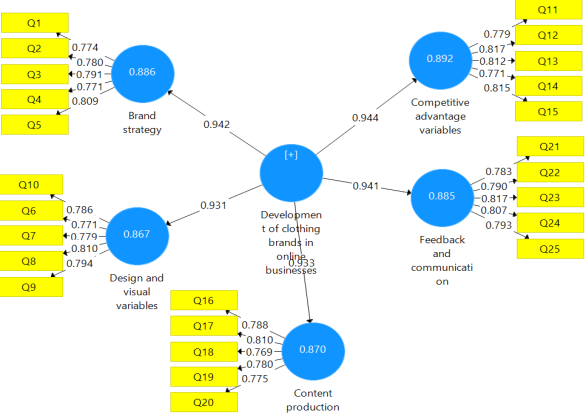
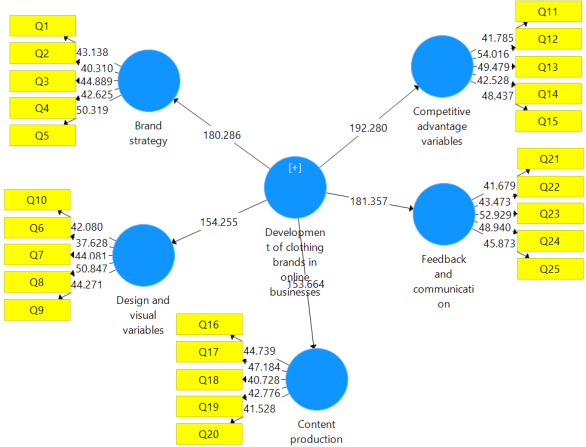
Development of clothing brands in online businesses -> Brand strategy variables | 0.942 | 0.942 | 0.005 | 180.286 | 0 | Approved |
Developing a clothing brand in online businesses -> Feedback and communication variables | 0.944 | 0.944 | 0.005 | 192.28 | 0 | Approved |
Developing a clothing brand in online businesses -> Content production variables | 0.933 | 0.933 | 0.006 | 153.664 | 0 | Approved |
Development of clothing brands in online businesses -> Design and visual variables | 0.931 | 0.931 | 0.006 | 154.255 | 0 | Approved |
Developing a clothing brand in online businesses -> Competitive advantage variables | 0.941 | 0.941 | 0.005 | 181.357 | 0 | Approved |
CEO | Chief Executive Officer |
e-commerce | Electronic Commerce |
| [1] | Afrashteh, Mansouri Ghara, Arezou, Emami Ghara Hajloo, Valipour, Peyman... Tiam. (2023). A review of sustainability and development factors in Iran's textile and apparel industry. Textile and Apparel Science and Technology. 12(3). |
| [2] | Azimi, Foruzandeh, Vazifehdoost, Saeednia. (2022). Infrastructural factors affecting future management and the development of Iran's clothing industry. Future Studies in Management. 130 creating sustainable development in the clothing industry of Shahrekord city. Textile and Clothing (3). |
| [3] | Farhadi, Fathi, Seyed Amiri, Mohammad Yousofi Vardanjani. (2023). Identification and ranking of components for g Science and Technology. 12(3). |
| [4] | Kashki, Mona, Nayebzadeh, Davoodi Rokn Abadi, Hamdi, Karim. (2024). Identification of the dimensions and components of digital marketing tools in startups active in the fashion and apparel industry in Iran. Textile and Apparel Science and Technology, 12(4). |
| [5] | Morsali Hir Kianush. (2022). The impact of social media marketing on the intention to purchase fitness apparel during the COVID-19 pandemic. |
| [6] | Baabdullah, A. M. (2018). Consumer adoption of Mobile Social Network Games (M-SNGs) in Saudi Arabia: The role of social influence, hedonic motivation and trust. Technol Soc., 53, 91–102. |
| [7] | Black, I., & Veloutsou, C. (2017). Working consumers: Co-creation of brand identity, consumer identity and brand community identity. Journal of business research, 70, 416-429. |
| [8] | Christensen, New Product FumblesOrganizing for the Ramp-up Process. Frederiksberg: Copenhagen Business School (CBS), 2018. |
| [9] | De Ponte, C., Liscio, M. C., & Sospiro, P. (2023). State of the art on the Nexus between sustainability, fashion industry and sustainable business model. Sustainable Chemistry and Pharmacy, 32, 100968. |
| [10] | Feng, N. (2014). Building a Strong Brand and Managing Brand. In ASEE 2014 Zone 1 Conference. |
| [11] | González-Díaz, R. R.; Acevedo-Duque, Á. E.; Guanilo-Gómez, S. L.; Cachicatari-Vargas, E. (2021). Business counterintelligence as a protection strategy for SMEs. Entrep. Sustain. Issues, 8, 340–352. |
| [12] | Hegner, S. M., Fenko, A., & Teravest, A. (2017). Using the theory of planned behaviour to understand brand love. Journal of Product & Brand Management. |
| [13] | Julia, Gradowska., N., Wolosowicz. (2022). Sustainable development of clothing brands based on LPP S. A. Analysis. Humanities & social sciences reviews, |
| [14] | Kähr, A., Nyffenegger, B., Krohmer, H., & Hoyer, W. D. (2016). When hostile consumers wreak havoc on your brand: The phenomenon of consumer brand sabotage. Journal of marketing, 80(3), 25-41. |
| [15] | Keller, K. L. (2016). Reflections on customer-based brand equity: perspectives, progress, and priorities. AMS review, 6(1), 1-16. |
| [16] | Klein and F. Şener, (2023). “Product innovation, diffusion and endogenous growth,” Rev. Econ. Dyn., vol. 48, pp. 178–201. |
| [17] | Kucharska, W., & Mikołajczak, P. (2018). Personal branding of artists and art-designers: necessity or desire? Journal of Product & Brand Management. |
| [18] | Ng, S. Y., & Mok, P. Y. (2023). AN EMPIRICAL STUDY ON CONSUMER PREFERENCES FOR ONLINE CUSTOMISED CLOTHING PLATFORM. IADIS International Journal on Computer Science & Information Systems, 18(2). |
| [19] | Olha, Podra., N., Petryshyn. (2022). Peculiarities of the creation and implementation of a company brand development strategy under conditions of European integration. Menedžment ta pìdpriêmnictvo v Ukraïnì: etapi stanovlennâ ì problemi rozvitku, |
| [20] | Petrova, S., Ivanova, Z., & Marinov, I. (2023). IMPACT OF INFORMATION AND COMMUNICATION TECHNOLOGY ON THE RETAIL INDUSTRY: CHANGES IN ONLINE CLOTHING SHOPPING IN THE EUROPEAN UNION. Economic and Social Development: Book of Proceedings, 62-72. |
| [21] | Rahman, M. M., Hasan, M. J., Deb, B. C., Rahman, M. S., & Kabir, A. S. (2023). The effect of social media entrepreneurship on sustainable development: Evidence from online clothing shops in Bangladesh. Heliyon, 9(9). |
| [22] | Reyhani, Ghazi Nouri, Seyed Sepehr, Radfar. (2024). New Product Development Pattern in Iranian Fashion and Apparel Industry. Textile and Apparel Science and Technology. 13(1). |
| [23] | Wu, M., Jiang, Y., & Zhang, L. (2023). Research on the current situation and development trend of adaptive clothing demand. Journal of Innovation and Development, 2(1), 29-35. |
| [24] | Zhe, Li., Huan, Tian. (2019). Research on the core value of clothing brand based on the development trend of fabric. |
| [25] | Zhang, D., Chun, D., & Huang, M. (2023). Consumer behavior under social network platform influencing factors and marketing strategies. Open Journal of Business and Management, 11(2), 603-612. |
APA Style
Hashemi, Z., Valipour, P., Veisari, E. F. (2025). Presentation of a Brand Development Model: A Meta-analysis in the Online Clothing Industry. Research and Innovation, 1(1), 56-70. https://doi.org/10.11648/j.ri.20250101.18
ACS Style
Hashemi, Z.; Valipour, P.; Veisari, E. F. Presentation of a Brand Development Model: A Meta-analysis in the Online Clothing Industry. Res. Innovation 2025, 1(1), 56-70. doi: 10.11648/j.ri.20250101.18
AMA Style
Hashemi Z, Valipour P, Veisari EF. Presentation of a Brand Development Model: A Meta-analysis in the Online Clothing Industry. Res Innovation. 2025;1(1):56-70. doi: 10.11648/j.ri.20250101.18
@article{10.11648/j.ri.20250101.18,
  author = {Zahra Hashemi and Peiman Valipour and Elham Fazeli Veisari},
  title = {Presentation of a Brand Development Model:
A Meta-analysis in the Online Clothing Industry},
  journal = {Research and Innovation},
  volume = {1},
  number = {1},
  pages = {56-70},
  doi = {10.11648/j.ri.20250101.18},
  url = {https://doi.org/10.11648/j.ri.20250101.18},
  eprint = {https://article.sciencepublishinggroup.com/pdf/10.11648.j.ri.20250101.18},
  abstract = {Given the importance and necessity of branding in the clothing industry, this research was conducted with the aim of developing clothing brands in online businesses. This research is applied in terms of purpose and descriptive-survey in terms of method, and it has adopted a mixed (qualitative-quantitative) approach. In the first step of qualitative research, the method used was meta-analysis, and the statistical population included studies, books, and articles from 2014 to 2024 in the field of clothing brand development in online businesses, including works published in reputable scientific and promotional journals in this period. In the second step, the quantitative research method was used using confirmatory factor analysis and the statistical population included 238 senior and middle managers of clothing manufacturing companies in Mazandaran, of which a sample of 147 was determined using the Cochran formula. In the qualitative stage, meta-analysis was used, and in the quantitative stage, PLS structural equation modeling was used. The findings identify five main dimensions: brand strategy, design and visual variables, competitive advantage, content production and feedback, and communication, each of which includes specific components. The relationships between dimensions and components were verified through path analysis, validating the proposed model. The overall fit of the model, calculated using the GOF formula, indicates a strong fit. This study provides practical insights into the strategic development of apparel brands in online markets, enhancing brand competitiveness, and customer engagement.},
 year = {2025}
}
TY  - JOUR
T1  - Presentation of a Brand Development Model:
A Meta-analysis in the Online Clothing Industry
AU  - Zahra Hashemi
AU  - Peiman Valipour
AU  - Elham Fazeli Veisari
Y1  - 2025/12/17
PY  - 2025
N1  - https://doi.org/10.11648/j.ri.20250101.18
DO  - 10.11648/j.ri.20250101.18
T2  - Research and Innovation
JF  - Research and Innovation
JO  - Research and Innovation
SP  - 56
EP  - 70
PB  - Science Publishing Group
SN  - 3070-6297
UR  - https://doi.org/10.11648/j.ri.20250101.18
AB  - Given the importance and necessity of branding in the clothing industry, this research was conducted with the aim of developing clothing brands in online businesses. This research is applied in terms of purpose and descriptive-survey in terms of method, and it has adopted a mixed (qualitative-quantitative) approach. In the first step of qualitative research, the method used was meta-analysis, and the statistical population included studies, books, and articles from 2014 to 2024 in the field of clothing brand development in online businesses, including works published in reputable scientific and promotional journals in this period. In the second step, the quantitative research method was used using confirmatory factor analysis and the statistical population included 238 senior and middle managers of clothing manufacturing companies in Mazandaran, of which a sample of 147 was determined using the Cochran formula. In the qualitative stage, meta-analysis was used, and in the quantitative stage, PLS structural equation modeling was used. The findings identify five main dimensions: brand strategy, design and visual variables, competitive advantage, content production and feedback, and communication, each of which includes specific components. The relationships between dimensions and components were verified through path analysis, validating the proposed model. The overall fit of the model, calculated using the GOF formula, indicates a strong fit. This study provides practical insights into the strategic development of apparel brands in online markets, enhancing brand competitiveness, and customer engagement.
VL  - 1
IS  - 1
ER  -
Department of Textile and Apparel Engineering I.A., Islamic Azad University, Qaemshahr, Iran
Department of Textile and Apparel Engineering I.A., Islamic Azad University, Qaemshahr, Iran
Department of Management and accounting, To.c., Islamic Azad University, Tonekabon, Iran




 Share This Article
 Twitter
 Linked In
 Facebook
 Copy
Copy Download