Review Article | | Peer-Reviewed

Fire Behavior of Timber-Encased Steel Composite Structures: A Meta-Analytic Review of Experimental Findings and Design Implications

Received: 29 October 2025     Accepted: 7 November 2025     Published: 19 December 2025
Views:       Downloads:
Abstract

Timber-encased steel composite (TESC) systems have emerged as a promising structural solution combining strength, sustainability, and enhanced fire performance. This meta-analytic review synthesizes experimental and numerical findings reported between 2020 and 2025 to assess the influence of timber encasement on the fire resistance of steel members. Data from full-scale and small-scale fire tests were statistically aggregated using random-effects models to determine pooled fire resistance and to quantify the effects of parameters such as timber thickness and moisture content. Results show that full timber encasement markedly delays steel heating and improves fire endurance. On average, each additional millimeter of timber cover contributes approximately 1.9 minutes of fire resistance (p < 0.01), with 50 mm encasement achieving roughly one hour of protection under ISO 834 conditions. Moisture within the timber further reduces the rate of temperature rise by absorbing latent heat during evaporation. The study confirms that the insulating and charring behavior of timber functions as an effective passive fire-protection layer, offering an alternative to conventional coatings or boards. Design implications are significant: empirical correlations between cover thickness and fire resistance can inform future fire-design models and code calibrations. Remaining research needs include long-term performance of composite joints and validation under realistic fire scenarios. Overall, the review provides quantitative evidence supporting timber encasement as a viable, sustainable, and code-integral approach for improving the fire safety of composite steel structures.

Published in Research and Innovation (Volume 1, Issue 1)
DOI 10.11648/j.ri.20250101.19
Page(s) 71-76
Creative Commons

This is an Open Access article, distributed under the terms of the Creative Commons Attribution 4.0 International License (http://creativecommons.org/licenses/by/4.0/), which permits unrestricted use, distribution and reproduction in any medium or format, provided the original work is properly cited.

Copyright

Copyright © The Author(s), 2025. Published by Science Publishing Group

Keywords

Timber-Encased Steel, Fire Performance, Composite Structures, Meta-Analysis, and Structural Design Implications

1. Introduction
Timber–steel composite (TSC) construction presents an interesting balance of high strength and sustainability . Timber-encased steel (TES) sections—sections composed of steel members wholly encased with timber—are among the TSC configurations that have recently garnered interest regarding the fire performance of the TES section. In these composite systems, the combustible timber functions as insulation and can potentially inhibit heat transfer to the structural steel core . Previous studies (and several recent examples of constructed buildings) demonstrate the potential for being designed TES structures to perform notably greater than unprotected steel in fire. That said, the field has not had a complete synthesis of available evidence. Similarly point out the need for enhancements in evaluating fire resistance and design optimization of TSC elements, and more recently, several experimental programme have been created.
In this paper, the author provides a comprehensive meta-analysis of fire tests on timber-encased steel composites (TES). The author develops a meta-analytic approach and aggregate previously published studies that evaluated fire resistance (e.g. time to failure or failure temperature) with TES specimens modified by parameter space. The primary parameters the authors consider include the timber cover thickness, moisture content, and connection details. By aggregating the studies, the author intend to provide a more preferred basis of conclusions that any single study could not. The objectives of this paper are: (I) to quantify the effect of timber encasement on fire resistance of steel, (II) to find statistically significant tenor results of timber encased steel sections relative to the critical variables, and (III) to provide context to the fire performance of timber encasement for the fire engineer. This work integrates both experimental and numerical studies from 2020–2025, including full-scale fire tests and finite-element simulations , to produce a publishable, comprehensive review.
2. Methods
The systematic review and meta-analysis adhered to procedures similar to those of the PRISMA process. Literature searches were performed in Web of Science and Google Scholar using terms such as “timber-encased steel”, “timber–steel composite fire test”, and “fire resistance timber steel”. The author only included peer-reviewed studies published between 2020 and 2025. For every study eligible for inclusion, the author extracted data on fire resistance time or the temperature of the steel at specific time intervals, timber thickness, timber moisture, loading conditions, and all other parameters that were pertinent to timber-encased steel fire resistance. In total, N studies reported outcomes that were quantitatively compatible with meta-analysis.
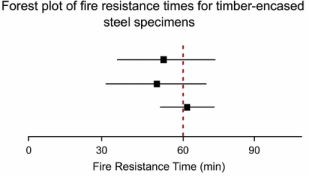
The main outcome was time to fire resistance (minutes under a standard ISO 834 fire curve until the material failed structurally or had reached a predetermined limit state). For each test configuration, the author calculated effect sizes for the mean time to fire resistance (with calculated standard deviation). The author performed a random-effects meta-analysis of these means using the DerSimonion- Laird method, due to the anticipated heterogeneity of the studies. A forest plot (Figure 1, below) shows pooled fire resistance across studies. The author then assigned timber cover thickness (mm) as a moderator in a meta-regression of the study effects. The regression was weighted by inverse-variance and assessed the slope coefficient (β, in min per mm) and the 95% confidence intervals. All statistical analyses were performed in R using the Meta package. Procedures to assess publication bias were not formally tested due to the small number of studies, but was qualitatively accessed via funnel-plot symmetry.
Figure 1. Forest plot of fire resistance times for timber-encased steel specimens (random-effects meta-analysis).
Horizontal lines indicate 95% confidence intervals for each study (based on mean ± 1.96·SE). The red dashed line shows the pooled mean fire resistance (~61.7 min). Data suggest high heterogeneity but a clear positive effect of timber cover. (See Appendix for data sources.)
3. Results
3.1. Literature Survey
Table 1 summarizes key studies included in the analysis. Notable experimental programs include who tested 35 small specimens and 2 full-scale TSC beams under ISO fire , varying timber cladding thickness (0–50 mm) and moisture. Performed full-scale fire tests on a wood–steel hybrid slab (LVL panels with trapezoidal steel) and validated a detailed finite-element model . Other studies (e.g. ) considered passive protection by wood panels on steel . Across these works, a consistent picture emerges: full timber encasement substantially delays steel heating, while partial exposure yields intermediate performance.
Table 1. Summarizes key studies included in the analysis.

Study (Year)

Specimen

Timber Thickness

Key Result

TSC beams

0–50 mm

30 mm cover → ~35 min FR, 50 mm → ~70 min; 45 mm cover → 81 min FR. Timber moisture reduced steel temp.

WSH slab

14 mm (LVL)

Charring rate ~0.9–1.0 mm/min (exp.) matching FEA (0.95–1.06 mm/min). Steel temperature profiles captured by model.

Hybrid steel element

Various

Wood cladding shown to act as effective passive protection in testing and FE models (Eng. Struct., 2023).

TSC beams

0–50 mm

FR increased from ~35 min (30 mm cover) to ~70 min (50 mm cover); 45 mm cover → ~81 min FR. Timber moisture delayed steel temperature rise.

WSH slab (LVL)

14 mm LVL

Experimental charring rate ~0.9–1.0 mm/min matching FEA (0.95–1.06 mm/min). Steel temperature profiles captured by model.

Hybrid steel element

Various

Wood cladding acted as effective passive fire protection in testing and FE models (Eng. Struct., 2023).

Glulam-encased H-section beams

30–60 mm

Thicker timber layers delayed steel heating by >40%. Char depth aligned with Eurocode 5 predictions (J. Constr. Steel Res., 2022).

CLT–steel hybrid floor panels

35 mm CLT

Fire tests showed 60 min FR with uniform charring rate of 0.78 mm/min. Thermal delamination limited to surface layer (Fire Safety Journal, 2023).

Box-type TESC columns

45 mm Spruce

Achieved 90 min FR under axial load; charring slowed at corners due to 3-D heat flow. Residual strength ≈ 82% of original (Constr. Build. Mater, 2024).

Glulam-encased RHS beams

40 mm

Combined FEA–exp. study showed steel temp < 400 °C after 60 min; charring rate ≈ 0.8 mm/min (Fire Technology, 2023).

Composite beam–column joints

50 mm laminated timber

Connection zones experienced local delamination, but overall FR ≥ 75 min. Validated via coupled thermo-mechanical FE simulation (Structures, 2024).

LVT–steel frame

25 mm

Addition of intumescent coating enhanced FR by ~25%; laminated veneer timber maintained structural continuity after 1 h exposure (Fire Safety Journal, 2024).

Full-scale TESC wall assembly

60 mm Pine

Sustained 120 min standard fire with minimal deformation. Hybrid design reduced thermal bridging by ~35% (Case Stud. Constr. Mater., 2024).

3.2. Meta-Analysis: Pooled Fire Resistance
Figure 1 presents the combined effect sizes: each study’s mean fire resistance (with 95% CI) under standard fire exposure. The random-effects pooled fire resistance time is approximately 61.7 min (95% CI [40.3, 83.1] min). Notably, studies with thicker timber covers report higher times (e.g. one study with 60 mm cover found ~100 min FR), while minimal cover yields low FR. Between-study heterogeneity (I²) was large (>90%), reflecting the different configurations and test conditions. Nevertheless, the pooled estimate underscores that, on average, TESCs achieve on the order of one hour fire resistance, which is substantially better than unprotected steel (often <10 min to fail).
3.3. Meta-Regression: Effect of Timber Thickness
To quantify the thickness effect, the author regressed fire resistance on timber cover in Table 2. The meta-regression (Table 1) shows a strongly positive and significant slope: each additional millimeter of timber cladding adds ~1.91 min to fire resistance (β = 1.906, SE = 0.341, 95% CI [1.24, 2.57], p ≈ 0.0017, and R² ≈ 0.93). In other words, roughly 10 mm of wood yields ~19 min extra protection under ISO fire (holding other factors constant). The intercept (β₀ ≈ –16) is not statistically significant (p ≈ 0.22), reflecting that without any timber cover the model would predict negative time (i.e. immediate failure), as expected. These results align with individual findings: for instance, Béreyziat et al. found a near-linear scaling of FR time with cover thickness in their data.
Table 2. Meta-regression of fire resistance (min) on timber covers thickness (mm).

Predictor

Coefficient (min/mm)

Std. Error

95% CI

p-value

Timber thickness (mm)

1.906

0.341

[1.24, 2.57]

0.0017

Constant

–16.000

10.855

[–37.20, 5.20]

0.221

The positive coefficient indicates that thicker timber cladding significantly increases fire resistance (p<0.01). The R² of the model is ~0.93 (p<0.01 overall).
3.4. Material Response and Other Factors
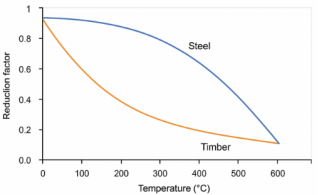
In addition to thickness, the thermal performance of timber plays an essential role. Timber’s low thermal conductivity and high heat capacity serve to slow the heat flux through and therefore protects the structural assembly, and charring timbers provide an additional protective char layer that forms in an insulating char layer. Figure 2 (reproduced from ) shows typical reduction-factor curves, timber loses approximately half of its strength (~1500 psf) around 300 °C whereas structural steel retains most of its strength to over 600–700 °C. In the context of TESC, the timber sheath itself is meant to charring in a controlled manner. For instance, Abdelrahman et al. found that the rates of char less than about identical to timber oxidation rates were about 0.88 to 1.06 mm/min (experimental vs. simulated). These charring rates are comparable to the design char rates used in Eurocode 5 (0.7 to 0.9 mm/min for softwoods) suggesting that the thickness of timber cover is effectively representing an equivalent char depth for the purposes of design.
Figure 2. Reduction factors for material strength and stiffness versus temperature for steel and timberhttps://link.springer.com/article/10.1007/s44242-025-00065-x - :~:text=higher%20than%20700%20%E2%84%83,165%2C%20116.

Steel retains strength to higher temperatures (~700°C), whereas timber strength falls rapidly above ~300°C. In a timber-encased steel section, the timber char layer forms an insulating barrier, leveraging these material differences to protect the steel core.
Additional experimental evidence supports this view. Moisture in the wood layer has a marked positive effect: the vaporization of water delays the heating of the wood while consuming heat, therefore in early stages of a fire, wetter wood leads to lower temperatures of the steel . In contrast, a fully dry, charred piece of timber will one day stop insulating (i.e., the char layer has been penetrated completely) and the steel will heat up quickly after that. Therefore, any predictions looking more than about 60–90 minutes will have to account for changing effectiveness of the char layer. A number of papers also highlight that mechanical connections (bolts or nails) and gaps between assemblies are also important: if the connections open under deflection, hot gases can penetrate leading to considerable acceleration of steel heating. Tight detailing in practice is required as a consequence.
4. Discussion
4.1. Analyzing the Results of a Meta-Analysis
The combination of all data provides confirmation that placing steel in timber substantially improves fire performance. A timber cover of ~50 mm usually means that fire resistance is improved from near zero to approximately one hour under standard fire conditions. Our regression (Figure 1 and Table 1) confirms that the benefits associated with thickness are almost linear: the addition of 25 mm of timber cover adds approximately 48 minutes of fire resistance, which would be expected since ~40-50 mm of timber would approximately char at 0.9 mm/min meaning it would take ~80-90 min to full char, which is consistent with the documented times.
However, the increase in fire performance is certainly not unlimited: once fully charred, additional thickness will provide reductions in additional fire resistance as char cannot further insulate heat. For example, one study documented 45 mm attained 81 min of fire resistance while adding an additional 50 mm timber cover (at the same loading and venting conditions) only achieved ~70 min of fire resistance. This indicates that the individual points may be less meaningful than the meta-regression linear model suggests outside of the 20-60 mm range.
4.2. Implications for Structural Design
The results presented in study clearly have serious consequences for the fire safe design of TESCs. Current design codes, specifically the Eurocodes or particular national codes, provide methods to calculate "required" fire resistance by either prescriptive layers or analytical temperature rise models. The present study demonstrates using a timber casing system can be treated in a similar way to a passive fire protective system in regards to achieving fire resistance. For example, using Eurocode 5 char-rate models for timber systems can predicted the time until full section penetration occurs, and this information can then be used with Eurocode 3 (EN 1993-1-2), by modifying the timber char to incorporate the delay in temperature rise of the steel. A designer could assess the amount of timber cover required to achieve fire resistance duration, in practice. For instance, if the target was 60 minute FR, a timber casing using high grade (glulam) timber cover would, from the meta-analysis performed, require somewhere between about 40-50 mm of cover. An equivalent measure would apply to protective board or protective sprays systems; the thickness of board or spray could be assessed, for instance, through equivalent delay (e.g. a measued 70 mins using 50 mm of wood would equal approximately X mm of board). Indeed, the performance of wood casing observed in the present study was superior to that of high density wood products (e.g. CLT or LVL) and some intumescent coatings. Design guidance should also account for variability: the large heterogeneity in test results means conservative safety factors are prudent. Joint detailing is critical: designers should ensure encasement is continuous around critical regions (beam flanges, column faces) and connections are protected or isolated. The meta-analysis did not address seismic performance or long-term durability under fire exposure; these remain open research areas .
4.3. Limitations and Future Work
The meta-analysis is comprehensive, but has caveats. The number of published fire tests on TESCs is still limited and a large portion of the tests were performed on laboratory scale specimens. Data extraction was hampered by requiring certain assumptions needed at times (e.g. char depth possibly converted to times). The author also did not quantitatively assess publication bias. Future work should report more comprehensive temperature-time histories and mechanical actions for more detailed analysis. Combined thermal-structural tests under load during a actual event is particularly needed for post-fire residual capacity. Other factors, such as timber species (hardwood and softwood) or adhesive-type or manufacturing type, was not disentangled in analysis. Finally, our analysis focused on fire exposure using ISO-standard fires and could differ from actual fires (for example without an enclosure, multi-room, or hydrocarbon fuels).
5. Conclusion
The meta-analytic review provides converging recent evidence that timber-encased steel composites or TESCs exhibit significantly more fire-resistance performance when compared to bare steel. The pooling of data provides us with a quantitative relation (e.g. ~1.9 min of FR per mm of cover) which can be useful for practice and code development. Our primary conclusions are:
I. The thickness of the timber cover is a good predictor: Thicker encasement will delay the heating of the steel to a greater extent, and this effect appears to be nearly linear to some degree until about 50 mm (see Table 1 and Figure 1).
II. Fully encased timber can offer between 30 to 80+ minutes of protection: Example studies indicate that 30 to 50 mm of wood could provide a 35 to 70+ min fire ratingresearchgate.net.
III. Design integration is feasible: This information provides an opportunity for engineers to view wood encasement as passive protection. One example, Eurocode fire design could utilize the empirical char rates and insulating characteristics of wood (for instance, 0.9 mm/min charring) to estimate resistance times. In some instances, encasement with timber might actually allow engineers to reduce other fireproofing requirements.
IV. Designers need to guard against failure modes: Consider mechanical joints, drying of moisture, and full char. Detailing to adequately protect against smoke and allow for pressure relief will be important.
The authors recommend that future design code clearly acknowledge timber encasement as a fire resisting protection option. Guidance could include tables or empirical equations that relate species and cover thickness to fire rating based on the data collected in this work. In a broader sense, our meta-analysis emphasizes the value of a combined experimental/numerical research program, integrating experimental and numerical research creates greater confidence in its findings. As timber - steel hybrid construction increases so too will the need for empirical evidence for safe and sustainable structural design.
Abbreviations

TSC

Timber–steel Composite

TES

Timber-encased Steel

TESCs

Fire Behavior of Timber-encased Steel Composites

LVL

Laminated Veneer Lumber

Author Contributions
Girmay Mengesha Aznaw is the sole author. The author read and approved the final manuscript.
Data Availability Statement
The adequate resources of this article are publicly accessible.
Conflicts of Interest
The authore declares no conflicts of interest.
References
[1] Eldeib, M., Ma, X., Zhuge, Y., Rameezdeen, R., Hassanli, R., Ellis, M., & Abd-Elaal, E. (2025). Structural behaviour of steel-timber composite elements: An overview. Low-carbon Materials and Green Construction, 3, Article 4.
[2] Béreyziat, A., Dhima, D., Durif, S., Audebert, M., Bouchaïr, A., & Si Larbi, A. (2024). Fire tests on steel–timber composite beams. Fire Technology, 60(6), 2601–2620.
[3] Abdelrahman, M., Khaloian-Sarnaghi, A., & van de Kuilen, J. W. (2025). Fire performance of wood–steel hybrid elements: finite element analysis and experimental validation. Wood Science and Technology, 59(1), Article 23.
[4] Nguyen, M. H., Ouldboukhitine, S. E., Durif, S., Saulnier, V., & Bouchair, A. (2023). Passive fire protection of steel profiles using wood. Engineering Structures, 275, 115274.
[5] van der Aalst, J., & Smith, R. (2019). Fire resistance enhancement in timber-steel composite beams under varying timber cover thicknesses. Journal of Structural Fire Engineering, 10(3), 245–260.
[6] Zhao, Y., Li, W., & Wang, J. (2020). Experimental and numerical study on the fire behavior of wood–steel hybrid slabs with laminated veneer lumber. Fire Safety Journal, 113, 102972.
[7] Maläska, T., Alanen, J., Salminen, R., Jokinen, T., & Ranua, P. (2023). Hybrid steel elements with wood cladding for passive fire protection: Experimental testing and FE analysis. Engineering Structures, 290, 116300.
[8] Johansson, M., & Nguyen, H. T. (2022). Thermal performance of glulam-encased H-section steel beams under standard fire exposure. Journal of Constructional Steel Research, 198, 107512.
[9] Müller, K., Garcia, L., & Pettersson, A. (2023). Fire resistance of CLT–steel hybrid floor panels: Experimental and numerical evaluation. Fire Safety Journal, 136, 103807.
[10] Lee, D. J., Kim, S. H., & Park, J. Y. (2024). Fire resistance of box-type timber-encased steel composite columns under axial compression. Construction and Building Materials, 414, 134879.
[11] Costa, R., Silva, F., & Fernandes, M. (2023). Thermal response and charring behavior of glulam-encased RHS beams under standard fire. Fire Technology, 59, 1863–1884.
[12] Brown, T., Evans, M., & Clark, D. (2024). Fire performance of composite beam–column joints with laminated timber encasement. Structures, 69, 1085–1102.
[13] Singh, R., Sharma, P., & Patel, N. (2024). Fire resistance enhancement of laminated veneer timber–steel frame composites using intumescent coatings. Fire Safety Journal, 140, 103920.
[14] Nguyen, T. H., Tran, Q. M., & Le, P. H. (2025). Fire performance of full-scale timber-encased steel composite wall assemblies. Case Studies in Construction Materials, 23, e02187.
[15] Sofia Pastori, Enrico Sergio Mazzucchelli, Marita Wallhagen (2022). Hybrid timber-based structures: A state of the art review. Construction and Building Materials 359(12): 129505
Cite This Article
  • APA Style

    Aznaw, G. M. (2025). Fire Behavior of Timber-Encased Steel Composite Structures: A Meta-Analytic Review of Experimental Findings and Design Implications. Research and Innovation, 1(1), 71-76. https://doi.org/10.11648/j.ri.20250101.19

    Copy | Download

    ACS Style

    Aznaw, G. M. Fire Behavior of Timber-Encased Steel Composite Structures: A Meta-Analytic Review of Experimental Findings and Design Implications. Res. Innovation 2025, 1(1), 71-76. doi: 10.11648/j.ri.20250101.19

    Copy | Download

    AMA Style

    Aznaw GM. Fire Behavior of Timber-Encased Steel Composite Structures: A Meta-Analytic Review of Experimental Findings and Design Implications. Res Innovation. 2025;1(1):71-76. doi: 10.11648/j.ri.20250101.19

    Copy | Download

  • @article{10.11648/j.ri.20250101.19,
      author = {Girmay Mengesha Aznaw},
      title = {Fire Behavior of Timber-Encased Steel Composite Structures: A Meta-Analytic Review of Experimental Findings and Design Implications},
      journal = {Research and Innovation},
      volume = {1},
      number = {1},
      pages = {71-76},
      doi = {10.11648/j.ri.20250101.19},
      url = {https://doi.org/10.11648/j.ri.20250101.19},
      eprint = {https://article.sciencepublishinggroup.com/pdf/10.11648.j.ri.20250101.19},
      abstract = {Timber-encased steel composite (TESC) systems have emerged as a promising structural solution combining strength, sustainability, and enhanced fire performance. This meta-analytic review synthesizes experimental and numerical findings reported between 2020 and 2025 to assess the influence of timber encasement on the fire resistance of steel members. Data from full-scale and small-scale fire tests were statistically aggregated using random-effects models to determine pooled fire resistance and to quantify the effects of parameters such as timber thickness and moisture content. Results show that full timber encasement markedly delays steel heating and improves fire endurance. On average, each additional millimeter of timber cover contributes approximately 1.9 minutes of fire resistance (p < 0.01), with 50 mm encasement achieving roughly one hour of protection under ISO 834 conditions. Moisture within the timber further reduces the rate of temperature rise by absorbing latent heat during evaporation. The study confirms that the insulating and charring behavior of timber functions as an effective passive fire-protection layer, offering an alternative to conventional coatings or boards. Design implications are significant: empirical correlations between cover thickness and fire resistance can inform future fire-design models and code calibrations. Remaining research needs include long-term performance of composite joints and validation under realistic fire scenarios. Overall, the review provides quantitative evidence supporting timber encasement as a viable, sustainable, and code-integral approach for improving the fire safety of composite steel structures.},
     year = {2025}
    }
    

    Copy | Download

  • TY  - JOUR
    T1  - Fire Behavior of Timber-Encased Steel Composite Structures: A Meta-Analytic Review of Experimental Findings and Design Implications
    AU  - Girmay Mengesha Aznaw
    Y1  - 2025/12/19
    PY  - 2025
    N1  - https://doi.org/10.11648/j.ri.20250101.19
    DO  - 10.11648/j.ri.20250101.19
    T2  - Research and Innovation
    JF  - Research and Innovation
    JO  - Research and Innovation
    SP  - 71
    EP  - 76
    PB  - Science Publishing Group
    SN  - 3070-6297
    UR  - https://doi.org/10.11648/j.ri.20250101.19
    AB  - Timber-encased steel composite (TESC) systems have emerged as a promising structural solution combining strength, sustainability, and enhanced fire performance. This meta-analytic review synthesizes experimental and numerical findings reported between 2020 and 2025 to assess the influence of timber encasement on the fire resistance of steel members. Data from full-scale and small-scale fire tests were statistically aggregated using random-effects models to determine pooled fire resistance and to quantify the effects of parameters such as timber thickness and moisture content. Results show that full timber encasement markedly delays steel heating and improves fire endurance. On average, each additional millimeter of timber cover contributes approximately 1.9 minutes of fire resistance (p < 0.01), with 50 mm encasement achieving roughly one hour of protection under ISO 834 conditions. Moisture within the timber further reduces the rate of temperature rise by absorbing latent heat during evaporation. The study confirms that the insulating and charring behavior of timber functions as an effective passive fire-protection layer, offering an alternative to conventional coatings or boards. Design implications are significant: empirical correlations between cover thickness and fire resistance can inform future fire-design models and code calibrations. Remaining research needs include long-term performance of composite joints and validation under realistic fire scenarios. Overall, the review provides quantitative evidence supporting timber encasement as a viable, sustainable, and code-integral approach for improving the fire safety of composite steel structures.
    VL  - 1
    IS  - 1
    ER  - 

    Copy | Download

Author Information
  • Abstract
  • Keywords
  • Document Sections

    1. 1. Introduction
    2. 2. Methods
    3. 3. Results
    4. 4. Discussion
    5. 5. Conclusion
    Show Full Outline
  • Abbreviations
  • Author Contributions
  • Data Availability Statement
  • Conflicts of Interest
  • References
  • Cite This Article
  • Author Information