Research Article | | Peer-Reviewed

Soil Test Crop Response Based Phosphorus Calibration Study on Bread Wheat (Triticum Aestivum L.) in Adami Tulu Jido Kombolcha District, East Showa, Oromia, Ethiopia

Received: 4 November 2025     Accepted: 25 November 2025     Published: 20 December 2025
Views:       Downloads:
Abstract

Agricultural production and land productivity have been declining due to various factors, with unbalanced fertilizer application identified as a major cause. To address this issue, soil test-based crop response fertilizer recommendations offer an effective solution. An on-farm experiment was conducted in Adami Tulu Jido Kombolcha district over three consecutive cropping seasons (2022-2024) to determine the optimum nitrogen (N) level, phosphorous critical level (Pc), and phosphorus requirement factor (Pf) for bread wheat production. In the first year, fifteen factorial treatments combining five nitrogen levels (0, 23, 46, 69, and 92 kg/ha) and four phosphorus levels (0, 23, 46, and 92 kg/ha) were tested using a randomized complete block design with three replications on 9m² plots. Bread wheat variety Kingbird was used as the test crop. In the subsequent two years, the optimum nitrogen rate (46 kg/ha) identified in the first year was uniformly applied, while five phosphorus levels (0, 10, 20, 30, and 40 kg/ha) were evaluated to determine phosphorus critical level and requirement factor. Grain yield data were analyzed using SAS statistical software with mean comparisons by LSD at p<0.05, and partial budget analysis was conducted using CIMMYT guidelines. Results showed significant differences among treatments, with the highest grain yield of 3296.5 kg/ha obtained from the combined application of 46 kg/ha N and 69 kg/ha P, while the control plot yielded 2330.2 kg/ha. The economically optimum nitrogen rate was 46 kg/ha, with phosphorus critical level and phosphorus requirement factor determined as 19.92 ppm and 2.38, respectively. These findings provide essential parameters for soil test-based fertilizer recommendations to enhance bread wheat productivity in Adami Tulu Jido Kombolcha district.

Published in Research and Innovation (Volume 2, Issue 1)
DOI 10.11648/j.ri.20260201.11
Page(s) 1-8
Creative Commons

This is an Open Access article, distributed under the terms of the Creative Commons Attribution 4.0 International License (http://creativecommons.org/licenses/by/4.0/), which permits unrestricted use, distribution and reproduction in any medium or format, provided the original work is properly cited.

Copyright

Copyright © The Author(s), 2025. Published by Science Publishing Group

Keywords

Soil Test-based, Fertilizer Application, Productivity Increase, Economic Benefit

1. Introduction
Ethiopia ranks as the second-largest wheat producer in sub-Saharan Africa, cultivating an estimated area of approximately 1.6 million hectares . Despite this significant contribution, wheat production in Ethiopia ranks third in importance, following teff (Eragrostis tef), maize (Zea mays), and sorghum. Wheat (Triticum aestivum L.) serves as one of the world’s most vital staple foods, feeding nearly one-third of the global population . Given its critical role in food security, enhancing Ethiopia’s wheat production capacity is fundamental to addressing the prevailing food supply challenges. This can be achieved by efficiently leveraging the country’s abundant human and natural resources.
Crop production, including wheat, is influenced by a numerous of complex and interrelated factors such as soil fertility, pest and disease pressures, climatic conditions, and the adaptive management skills of farmers . Among these, soil fertility is a key determinant, with fertilizer use being central to nutrient management strategies. In Ethiopia, fertilizer applications have predominantly targeted nitrogen and phosphorus nutrients, mostly through the use of NPS (Nitrogen, Phosphorus, Sulfur) and urea fertilizers, across various crops cultivated for both market sale and food security purposes over recent years. Phosphorus (P), however, remains one of the most yield-limiting nutrients supplied by soils, and its availability tends to decline with continuous agricultural use .
Furthermore, the widespread application of blanket fertilizer recommendations often leads to improper nutrient use by farmers either applying rates above or substantially below recommended levels due to high input costs and other socio-economic factors. Soil phosphorus calibration studies are therefore essential as they provide critical information on the optimal amount of nutrients to be applied based on specific soil test values, aiming to maximize crop growth while minimizing nutrient waste and environmental harm. These calibrations are crop-specific and can vary significantly with different soil types . Consequently, soil test-based fertilization is crucial for enhancing crop productivity, promoting environmentally sustainable practices, and ensuring economic efficiency by applying fertilizers at the right rate, time, and place.
In line with this, the Adami Tulu Agricultural Research Center conducted soil test-based phosphorus calibration study during the 2022-2024 G.C cropping seasons in the Adami Tulu Jido Kombolcha District, targeting bread wheat production with the following objectives.
Objectives
1) To determine p- critical and p-requirement factor for wheat production in Adami Tulu Jido Kombolcha district
2) To determine Economically optimum N-fertilizer for wheat in the district
3) To develop guide line for soil test and crop response to fertilizers on representative soils in the district
2. Materials and Methods
2.1. Description of the Study Area
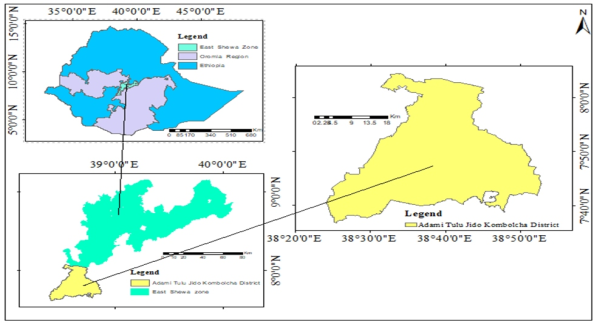
The study was conducted in the Central Rift Valley part of Ethiopia in Oromia Region, Adami Tulu-Jido Kombolcha woreda. Geographically the area is located between 38°25’E and 38° 55’E and 7°35’N and 8°05’N and is bordered by Southern Nations, Nationalities and Peoples’ Region (SNNPR) in the west and north west, Dugda-Bora woreda in the north, Arsi zone in the east and Arsi Negele woreda in the south. The capital city of the district was found at distance of about 160 km from Addis Ababa which is capital city of country Ethiopia. The district has semi-arid and arid agro-climatic zones and lies between 1500_2300 m. a.s.l. and it receives unevenly distributed average annual rainfall of 760.9 mm per annum. The long-term mean minimum and the mean maximum temperature is 12.6 and 27°C respectively. Mollic Andosols are the dominant soil group in the district.
Figure 1. Map of the Study Area.
2.2. Site Selection, Experimental Procedures, Treatments and Design
To obtained representative for experimental sites composite soil samples were collected from farmers fields in Adamu Tulu Jido Kombolcha district, where bread wheat is a dominant crop. Based on available soil P values the fields were categorized into very low, low, and moderate available soil P contents.
On-farm field experiments were conducted in Adami Tulu Jido Kombolcha district for three consecutive main cropping seasons 2022-2024. In the first year factorial combination of five levels of N rates (0, 23, 46, 69 and 92 Kg/ha) and four rate of P (0, 20, 30, and 40 Kg/ha-) were applied to determine optimum nitrogen. In the second and third years six rates of P (0, 10, 20, 30, 40 and 50 Kg/ha) with recommended N rate (46 Kg/ha) were used to determine Pc and Pf.
Treatments laid out in RCBD with three replications, plot size 3 m x 3 m (9 m2) using bread wheat (King bird variety) as test crop, N source urea, P source TSP and DAP both in first and second year were used. Land preparation were done oxen while others agronomic managements seed rate (150 kg/ha), hand weeding, herbicide and row planting in 20 cm according to the recommendations were applied.
2.3. Soil Data and Laboratory Analysis
Following the standard soil sampling procedures, representative composite soil samples were collected from each farmer field at a depth of 0- 20 cm before planting. Each composite soil sample was subjected for chemical analysis (soil pH, OC, total N, available P, K, Ca, Mg, and CEC). Three weeks after planting, soil samples were collected from each plot at a depth of 20cm for the analysis of available phosphorous and soil pH in the second and third year.
Agronomic parameters to be collected: Yield, and yield components.
Economic data: Economic analysis was performed to investigate the economic feasibility of the treatments. The average yield was adjusted downwards to reflect the difference between the experimental plot yield and the yield obtained by the farmers. The average open market price (ETB kg-1) for NP fertilizers was used for analysis. For a treatment to be considered a worthwhile option to farmers, the minimum acceptable rate of return (MARR) should be 100% , which is suggested to be realistic.
2.4. Statistical Data Analysis
All agronomic and soil data which will be collected across locations was properly managed using the EXCEL computer software. The collected data was subjected to the analysis of variance using the SAS/STAT computer package version 9.0 or other available statistical software.
2.5. Determination of Critical P Concentration
Critical level of a nutrient in soils refers to a level below which the crops will readily respond to fertilizer application and above which the response diminishes at a faster rate or vanishes. There are two soil P test methods widely used by soil test laboratories in Ethiopia. Critical P value will be determined following the Cate-Nelson graphical method where soil P values were put on the X-axis and the relative yield values on the Y-axis. The Cate-Nelson graphical method is based on dividing the Y-X scatter diagram into four quadrants and minimizing the number of points in the positive quadrants while minimizing the number of points in the negative quadrants. Steps in the Cate-Nelson graphical methods are as follows:
Percentage yield values are obtained for a wide range of locations where results of fertilizer rate studies are available.
2.6. Determination of P Requirement Factor
Phosphorus requirement factor is the amount of P in kg needed to raise the soil P by 1ppm. Phosphorus requirement enables to determine the quantity of P required per hectare to raise the soil test by 1ppm, and to determine the amount of fertilizer required per hectare to bring the level of available P above the critical level. It will be calculated using available P values in samples collected from unfertilized and fertilized plots.
Phosphorus requirement factor is the amount of P in kg needed to raise the soil P by 1ppm, lastly the amount of P fertilizer to applied calculated by:
Rate of P fertilizer to be applied = (Critical P conc. - initial P values) *P requirement factor
3. Result and Discussions
3.1. Characterization of Initial Selected Soil Chemical Properties
Before planting, the soil pH at the experimental sites ranged from 6.28 to 6.86, indicating nearly neutral conditions (Table 1). Available soil phosphorus levels varied between 4.43 and 6.79 mg/kg, which is classified as very low according to . This generally low available phosphorus status, often below critical thresholds, suggests soil infertility and represents a major constraint to land productivity in the study area, underscoring the necessity for external phosphorus fertilizer application to support optimal crop growth and yield. Total nitrogen content ranged from 0.12 to 0.14%, indicating very low nitrogen availability, while soil organic carbon content ranged from 1.32 to 1.59%, also classified as very low. These findings align with , who reported that approximately 72.71% of soils in Adami Tulu Jido Kombolcha district exhibit medium available phosphorus levels (5 to 15 ppm), reflecting spatial variability from very low to low phosphorus availability. Additionally, soil pH in the region ranges from neutral to slightly alkaline (6.05 to 8.07), providing a favorable environment for major crops such as bread wheat.
Table 1. Initial Selected Soil Chemical Properties of Experimental Sites.

S.N

Parameters

Mean

Minimum

Maximum

Classification

References

1

pH

6.69

6.28

6.86

Near Neutral

2

TN (%)

0.13

0.12

0.14

Low

3

OC (%)

1.46

1.32

1.59

Very low

4

Ava. P (mg/kg)

5.58

4.43

6.79

Very low

5

CEC (mg/kg)

6.60

5.64

8.12

Very low

Source: and
3.2. Determination the Optimum Amount of Nitrogen in the First Year
As part of determining the critical phosphorus level and phosphorus requirement factor, the first-year trial focused on identifying the optimum nitrogen fertilizer rate. Partial budget analysis revealed that the highest net benefit was achieved with the combined application of 46 kg N and 46 kg P2O5 per hectare (Table 2). Consequently, 46% nitrogen, equivalent to 100 kg of urea fertilizer, was uniformly applied across all treatments during the second and third years to establish the phosphorus critical level and requirement factor.
Table 2. Determination of optimum Nitrogen by partial budget analysis .

Treatment No.

N (kg/ha)

P2O5 (kg/ha)

Mean Grain Yield (kg/ha)

Total Variable Cost (₨/ha)

Gross Income (₨/ha)

Net Benefit (₨/ha)

1

0

0

2475.30

0

99012

99012

2

23

0

2740.73

1750

109629.2

107879.2

3

46

0

2666.60

3500

106664

103164

4

69

0

2358.00

5250

94320

89070

5

92

0

2944.40

7000

117776

110776

6

0

46

2930.86

4477

117234.4

112757.4

7

23

46

2364.19

6227

94567.6

88340.6

8

46

46

3117.30

7977

124692

116715

9

69

46

2824.08

9727

112963.2

103236.2

10

92

46

2327.15

11477

93086

81609

11

0

92

2746.90

8954

109876

100922

12

23

92

3098.76

10704

123950.4

113246.4

13

46

92

2626.54

12454

105061.6

92607.6

14

69

92

3166.66

14204

126666.4

112462.4

15

92

92

3055.55

15954

122222

106268

3.3. Response of Wheat Grain Yield to N and P Fertilizers Application
Statistical analysis revealed that wheat grain yield was significantly influenced (p ≤ 0.05) by different nitrogen fertilizer rates during the first year (Table 3). The highest yield of 3117.9 kg/ha was obtained from combined application of 46 kg N and 46 kg P2O5 per hectare, while the lowest yield of 1775 kg/ha was observed in the control plot without fertilizer. This substantial yield improvement is attributed to the NP fertilizer's stimulation of vigorous vegetative growth, which in turn boosted the biological yield. These results align with , who documented increased yield due to NP fertilizer application up to an optimum dose. Additionally, reported that applying 46 kg N/ha significantly enhanced grain yield by improving the photosynthetic efficiency of wheat and increasing seed number per spike. Nonetheless, it is important to note that excessive nitrogen application may lead to lodging and a marked decline in yield, highlighting the necessity of carefully calibrated fertilizer rates for maximizing wheat productivity.
Table 3. Interaction and main effect N and P fertilizer on wheat grain yields in the first year.

Level of N (kg/ha)

Level of Phosphorous (P2O5) (kg/ha)

0

23

46

92

0

1775e

2554cd

3030a

2746b

23

2740b

2565cd

2351cd

3098a

46

2666bc

3093a

3117.9a

2691bc

69

2358cd

2516cd

2824ab

3066a

92

2944ab

2706bc

2327d

3055a

CV (%)

12.47

LSD (5%)

312

Means within column followed by the same letters are not significantly different at P ≤ 0.05
3.4. Effect of Phosphorous Fertilizer on Wheat Grain Yield and Available Phosphorous
The mean grain yield and soil available phosphorus measured 21 days after planting were significantly affected (p < 0.05) by different rates of phosphorus fertilizer application (Table 4). The highest grain yield, amounting to 3296.5 kg/ha, was obtained with the combined application of 46 kg/ha nitrogen and 69 kg/ha P2O5, whereas the control plot recorded the lowest yield of 2330.2 kg/ha. Similarly, the maximum biomass yield was observed under the treatment of 46 kg/ha N and 69 kg/ha P2O5, while the control plot exhibited the highest harvest index.
The lowest yield in control plots across studies highlights the baseline limitation of soil without phosphorus amendment, emphasizing the importance of phosphorus in wheat cultivation under local conditions.
In summary, the current results are consistent and support the evidence from recent Ethiopian wheat phosphorus calibration studies, underscoring the importance of balanced nutrient management and soil test-based fertilizer recommendations for optimizing wheat yield and biomass production.
Table 4. Effect of phosphorous fertilizer on wheat grain and straw yields.

No.

N Rate (kg/ha)

P2O5 Rate (kg/ha)

Grain Yield (kg/ha)

Biomass Yield (kg/ha)

Harvest Index (%)

1

46

0

2330.2b

7524.7b

48.02b

2

46

23

2810.0ab

8427.5ab

49.25ab

3

46

46

3057.9ab

8006.2ab

49.39ab

4

46

69

3296.5a

8373.5ab

52.68a

5

46

92

2459.7b

8759.3a

47.73b

CV (%)

17.77

15.5

14.33

LSD (5%)

633.52

466.79

3.81

Means within column followed by the same letters are not significantly different at P ≤ 0.05, BM =Biomass Yield, HI= Harvest Index
3.5. Critical P Concentration (Pc) for Bread Wheat
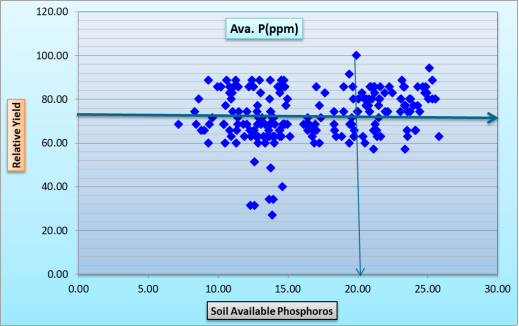
The critical phosphorus concentration (Pc) was determined using the Cate-Nelson diagram method . In this approach, soil phosphorus values are plotted on the X-axis and relative yield values on the Y-axis. The scatter plot is divided into two populations by adjusting perpendicular lines vertically and horizontally to maximize points in the two positive quadrants while minimizing points in the negative quadrants. The point where the vertical line intersects the X-axis defines the critical soil test phosphorus level.
In this study, relative grain yields of bread wheat were plotted against soil test phosphorus values (Olsen method) for a range of P application rates (0 to 50 kg P/ha). The Pc value identified by the Cate-Nelson method was approximately 19.92 mg/kg, corresponding to a mean relative yield response of about 67.75%. Beyond this critical level, relative crop yield showed a decreasing trend despite increases in soil test phosphorus.
Figure 2. Scattered plot of relative grain yield (%) of wheat and soil test phosphorus (Olsen) in Adami Tulu Jido Kombolcha District.
3.6. Phosphorous Requirement Factor
The phosphorus requirement factor (Pf) was calculated as 2.38 kg of phosphorus per hectare, representing the amount of phosphorus needed to increase the soil test phosphorus level by 1 ppm for bread wheat production in the Adami Tulu Jido Kombolcha district (Table 5). This factor allows for the calculation of the phosphorus fertilizer rate per hectare by considering the soil’s critical phosphorus concentration and the initial soil phosphorus content measured at each site prior to planting. This Pf value of 2.38 is somewhat low, suggesting that less phosphorus fertilizer is needed per unit increase in soil test P in Adami Tulu Jido Kombolcha district compared to other Ethiopian areas studied. This difference can be due to soil type, crop variety, management practices, or experimental conditions.
Table 5. Determination of P requirement factor (Pf) for bread wheat production in Adami Tulu Jido Kombolcha district.

Phosphorus Rate (kg/ha)

Average Soil Phosphorus (ppm)

Change in Phosphorus over Control (ppm)

Phosphorus Requirement Factor (Pf)

0

3.6

0

0

10

10.13

6.53

1.55

20

14.84

4.71

3.15

30

24.99

10.15

2.46

40

31.63

6.64

4.76

Average

2.38

Rate of P fertilizer to be applied = (Critical P conc. - initial P values) P requirement factor
4. Conclusion and Recommendations
In Ethiopia, the current nationwide blanket fertilizer recommendations were established several years ago and may no longer be suitable for today's agricultural conditions. These recommendations do not take into account the spatial and temporal variability in soil fertility, resulting in farmers applying uniform phosphorus (P) fertilizer rates regardless of differences in soil nutrient status. To address the challenges of declining crop yields and soil productivity linked to generalized fertilizer use, a site-specific; soil test-based phosphorus calibration study was conducted over three consecutive years (2022–2024) in the Adami Tulu Jido Kombolcha District.
The study determined the optimum nitrogen rate for bread wheat production in the district to be 46 kg N/ha in the first year. Additionally, critical soil phosphorus concentration (19.92 ppm) and phosphorus requirement factor (2.38) were identified for bread wheat during this calibration study. These findings highlight the importance of site-specific fertilizer recommendations modified to local soil fertility conditions. However, further verification of these results on farmers’ fields is necessary before the technology is widely disseminated to end users.
Abbreviations

CEC

Cation Exchange Capacity

PF

Phosphorous Requirement Factor

ETC

Ethiopian Birr

OC

Organic Carbon

LSD

Least Significance Difference

SOC

Soil Organic Carbon

MARR

Marginal Average Rate of Return

RCBD

Randomized Complete Block Design

PC

Phosphorous Critical

TN

Total Nitrogen

Conflicts of Interest
The authors declare no conflicts of interest.
References
[1] Admassu, L. (2017). Soils test phosphorous calibration for Tef [Eragrostis tef(Zucc.) Trotter] production on nitisols of Central Ethiopian Highlands. American-Eurasian Journal of Agricultural & Environmental Sciences 17(4), 320-331.
[2] Agegnehu, G., Nelson, P. N., Bird, M. I., & van Beek, C. (2015). Phosphorus response and fertilizer recommendations for wheat grown on nitisols in the Central Ethiopian Highlands. Communications in Soil Science and Plant Analysis, 46(19), 2411-2424.
[3] Alem L, Joseph M, Kethers S, Steele C, Wilkin son R. 2008. Information environments for supporting consistent registrar medical handover. HIM J; 37(1): 9-25.
[4] Altieri, M. A. 2018. Agroecology: the science of sustainableagriculture. CRC Press.
[5] Bekalu Abebe and Mamo Manchore. 2016. Effect of the Rateof N-Fertilizer Application on Growth and Yield of Wheat (Triticum aestivum L.) at Chencha, Southern Ethiopia. International Journal of Plant, Animal and EnvironmentalSciences 6(3): 168-175.
[6] CIMMYT (International Maize and Wheat Improvement Center).1998. From agronomic data to farmer recommendations: Aneconomic workbook. CIMMYT, Mexico.
[7] CSA (Central Statistical Agency). (2015). Report on Area and Crop Production forecast for Major Crops (for private Peasant Holdings Meher’ season). Addis Ababa, Ethiopia.
[8] CSA (Central Statistical Agency). 2016. Agricultural sample survey report on area and production of major crops: Privatepeasant holdings in meher season of 2015/2016 (Vol. I, No. 584). CSA, Addis Abeba, Ethiopia.
[9] Dejene Getahun, Dereje Girma, Abreham Feyisa, AjemaLemma, and Lello Dejene. 2020. Verification of Soil Test Crop Response Based Phosphorus Recommendation on Bread Wheat (Triticum Aestivum L.) in Yaya Gulele District of North Shewa Zone, Oromia. International Journal of Applied Agricultural Sciences. Vol. 6, No. 3, pp. 52-56.
[10] Edelstein, D. M., & Tonjes, D. J. (2012) Modeling an improvement in phosphorus utilization in tropical agriculture. Journal of Sustainable Agriculture, 36(1), 18-35,
[11] Fufa, B., and R. M. Hassan. 2005. Stochastic Technology and Crop Production Risk: The Case of Small-Scale Farmers in East Hararghe Zone of Oromia Regional State in Ethiopia, Strategies and Analysis for Growth and Access. Ethiopia.
[12] Hussain, I., Khan, M. A., & Khan, E. A. (2006). Bread wheat varieties as influenced by different nitrogen levels. Journal of Zhejiang University of Science, 7(1), 70-78. of Science, 7(1), 70-78.
[13] Kefyalew Assefa, Tilahun Firomsa, and Tadesse Hunduma (2017). Phosphorus Critical Level and Optimum Nitrogen Rate Determination on Teff for Sustainable Soil Fertility Management and Economical Teff Production at Lume Area of Oromia Region, Ethiopia. Journal of Biology, Agriculture and Healthcare, No. 19, 2017.
[14] Mulugeta Eshetu, Daniel Abegeja, Regassa Gosa, Tesfaye Ketama, Girma Getachew, Tilahun Chibsa. Soil Test Based Crop Response Phosphorus Calibration Study for Bread Wheat Production in Sinana District of Bale Zone, Southeastern Ethiopia. International Journal of Science and Qualitative Analysis. Vol. 8, No. 1, 2022, pp. 1-12.
Cite This Article
  • APA Style

    Workineh, M., Kitila, K. (2025). Soil Test Crop Response Based Phosphorus Calibration Study on Bread Wheat (Triticum Aestivum L.) in Adami Tulu Jido Kombolcha District, East Showa, Oromia, Ethiopia. Research and Innovation, 2(1), 1-8. https://doi.org/10.11648/j.ri.20260201.11

    Copy | Download

    ACS Style

    Workineh, M.; Kitila, K. Soil Test Crop Response Based Phosphorus Calibration Study on Bread Wheat (Triticum Aestivum L.) in Adami Tulu Jido Kombolcha District, East Showa, Oromia, Ethiopia. Res. Innovation 2025, 2(1), 1-8. doi: 10.11648/j.ri.20260201.11

    Copy | Download

    AMA Style

    Workineh M, Kitila K. Soil Test Crop Response Based Phosphorus Calibration Study on Bread Wheat (Triticum Aestivum L.) in Adami Tulu Jido Kombolcha District, East Showa, Oromia, Ethiopia. Res Innovation. 2025;2(1):1-8. doi: 10.11648/j.ri.20260201.11

    Copy | Download

  • @article{10.11648/j.ri.20260201.11,
      author = {Mekonnen Workineh and Kasahun Kitila},
      title = {Soil Test Crop Response Based Phosphorus Calibration Study on Bread Wheat (Triticum Aestivum L.) in Adami Tulu Jido Kombolcha District, East Showa, Oromia, Ethiopia},
      journal = {Research and Innovation},
      volume = {2},
      number = {1},
      pages = {1-8},
      doi = {10.11648/j.ri.20260201.11},
      url = {https://doi.org/10.11648/j.ri.20260201.11},
      eprint = {https://article.sciencepublishinggroup.com/pdf/10.11648.j.ri.20260201.11},
      abstract = {Agricultural production and land productivity have been declining due to various factors, with unbalanced fertilizer application identified as a major cause. To address this issue, soil test-based crop response fertilizer recommendations offer an effective solution. An on-farm experiment was conducted in Adami Tulu Jido Kombolcha district over three consecutive cropping seasons (2022-2024) to determine the optimum nitrogen (N) level, phosphorous critical level (Pc), and phosphorus requirement factor (Pf) for bread wheat production. In the first year, fifteen factorial treatments combining five nitrogen levels (0, 23, 46, 69, and 92 kg/ha) and four phosphorus levels (0, 23, 46, and 92 kg/ha) were tested using a randomized complete block design with three replications on 9m² plots. Bread wheat variety Kingbird was used as the test crop. In the subsequent two years, the optimum nitrogen rate (46 kg/ha) identified in the first year was uniformly applied, while five phosphorus levels (0, 10, 20, 30, and 40 kg/ha) were evaluated to determine phosphorus critical level and requirement factor. Grain yield data were analyzed using SAS statistical software with mean comparisons by LSD at p<0.05, and partial budget analysis was conducted using CIMMYT guidelines. Results showed significant differences among treatments, with the highest grain yield of 3296.5 kg/ha obtained from the combined application of 46 kg/ha N and 69 kg/ha P, while the control plot yielded 2330.2 kg/ha. The economically optimum nitrogen rate was 46 kg/ha, with phosphorus critical level and phosphorus requirement factor determined as 19.92 ppm and 2.38, respectively. These findings provide essential parameters for soil test-based fertilizer recommendations to enhance bread wheat productivity in Adami Tulu Jido Kombolcha district.},
     year = {2025}
    }
    

    Copy | Download

  • TY  - JOUR
    T1  - Soil Test Crop Response Based Phosphorus Calibration Study on Bread Wheat (Triticum Aestivum L.) in Adami Tulu Jido Kombolcha District, East Showa, Oromia, Ethiopia
    AU  - Mekonnen Workineh
    AU  - Kasahun Kitila
    Y1  - 2025/12/20
    PY  - 2025
    N1  - https://doi.org/10.11648/j.ri.20260201.11
    DO  - 10.11648/j.ri.20260201.11
    T2  - Research and Innovation
    JF  - Research and Innovation
    JO  - Research and Innovation
    SP  - 1
    EP  - 8
    PB  - Science Publishing Group
    SN  - 3070-6297
    UR  - https://doi.org/10.11648/j.ri.20260201.11
    AB  - Agricultural production and land productivity have been declining due to various factors, with unbalanced fertilizer application identified as a major cause. To address this issue, soil test-based crop response fertilizer recommendations offer an effective solution. An on-farm experiment was conducted in Adami Tulu Jido Kombolcha district over three consecutive cropping seasons (2022-2024) to determine the optimum nitrogen (N) level, phosphorous critical level (Pc), and phosphorus requirement factor (Pf) for bread wheat production. In the first year, fifteen factorial treatments combining five nitrogen levels (0, 23, 46, 69, and 92 kg/ha) and four phosphorus levels (0, 23, 46, and 92 kg/ha) were tested using a randomized complete block design with three replications on 9m² plots. Bread wheat variety Kingbird was used as the test crop. In the subsequent two years, the optimum nitrogen rate (46 kg/ha) identified in the first year was uniformly applied, while five phosphorus levels (0, 10, 20, 30, and 40 kg/ha) were evaluated to determine phosphorus critical level and requirement factor. Grain yield data were analyzed using SAS statistical software with mean comparisons by LSD at p<0.05, and partial budget analysis was conducted using CIMMYT guidelines. Results showed significant differences among treatments, with the highest grain yield of 3296.5 kg/ha obtained from the combined application of 46 kg/ha N and 69 kg/ha P, while the control plot yielded 2330.2 kg/ha. The economically optimum nitrogen rate was 46 kg/ha, with phosphorus critical level and phosphorus requirement factor determined as 19.92 ppm and 2.38, respectively. These findings provide essential parameters for soil test-based fertilizer recommendations to enhance bread wheat productivity in Adami Tulu Jido Kombolcha district.
    VL  - 2
    IS  - 1
    ER  - 

    Copy | Download

Author Information
  • Abstract
  • Keywords
  • Document Sections

    1. 1. Introduction
    2. 2. Materials and Methods
    3. 3. Result and Discussions
    4. 4. Conclusion and Recommendations
    Show Full Outline
  • Abbreviations
  • Conflicts of Interest
  • References
  • Cite This Article
  • Author Information